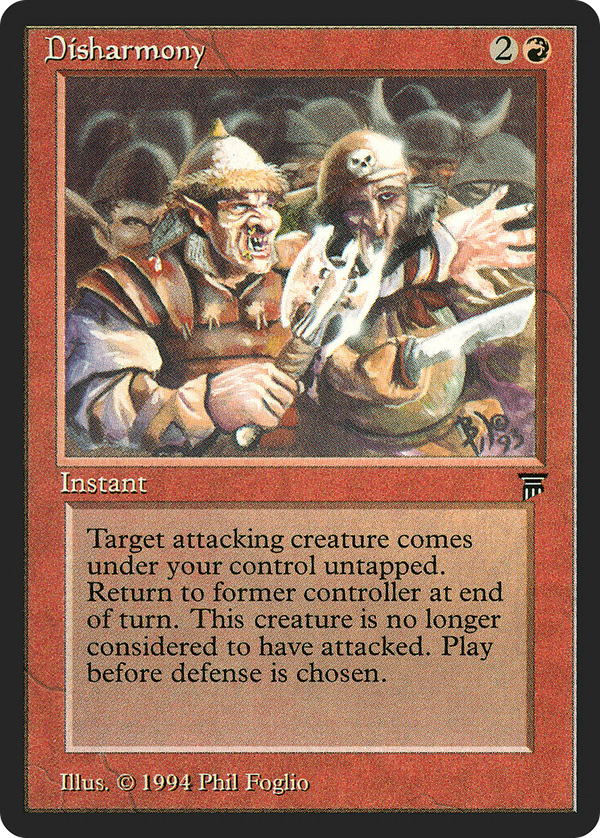
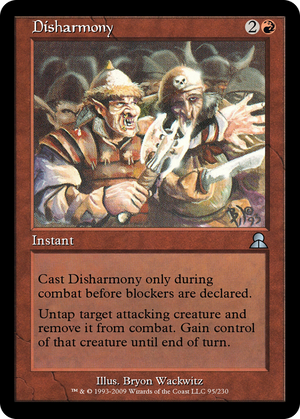
Disharmony


Threaten effects in red usually read as a tempo tax: take the creature, swing with it, lose it at end of turn, hope the math works. This one rewrites the structure by intervening mid-combat. The window is narrow on purpose (after attackers, before blockers), and inside that window the card does three discrete things at once: it untaps the creature, pulls it out of the combat its controller just committed to, and hands it to you for the turn. The opponent's alpha strike loses its biggest threat; that threat is now untapped and available to block on your side of the table. The "remove from combat" clause is the engineering trick, not a footnote. It is what lets the stolen creature block, and it is what makes the tempo swing asymmetric: you did not just borrow a beater, you deleted an attacker and gained a blocker in the same motion. Because the control effect lapses at end of turn, the value lives entirely inside the combat you cast it into; this is a defensive tool that happens to wear red's borrowing clothes, not a way to bank a creature for your own attack. The cost of that precision is the timing restriction, severe enough that the card cannot be held as a general-purpose answer; it has to be cast into a specific combat, against a specific creature, on a specific turn. The condition is not flavor text dressing a flexible removal spell; it is the entire load the design is built to carry.