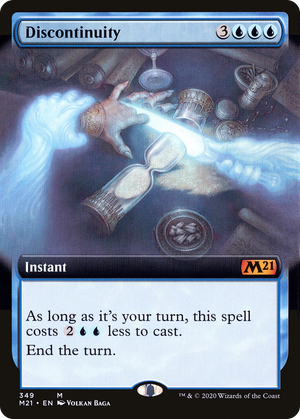
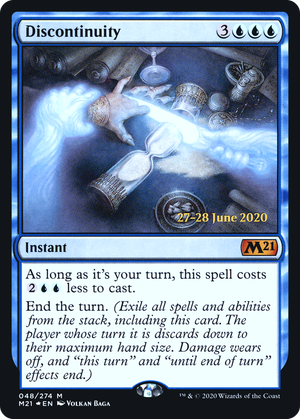
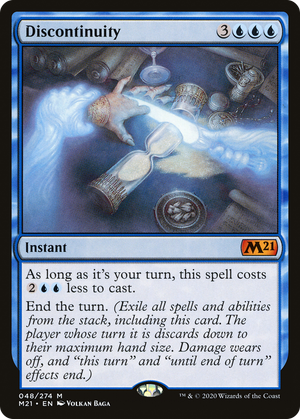
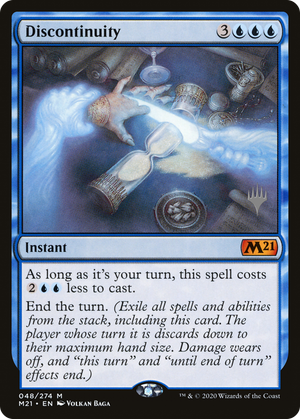
Discontinuity


Time Stop with a stack-timing catch built into its own reduction. On someone else's turn it demands the full six mana, a price steep enough that casting it defensively is a genuine commitment; on your own turn the cost drops by  to a mere
  , and that asymmetry is the whole design. The reduction is not a courtesy but a signal: the card is engineered to be a proactive weapon, not a reactive one. End the turn is the bluntest instrument in blue's kit, exiling every spell and ability on the stack including this one, which means it does not counter the opposing play so much as delete the entire remaining turn around it. Fired on your own turn for two mana, it becomes something stranger: a way to slam the door after you have done everything you wanted, ending combat before blockers deal damage, stranding an opponent's activated abilities in exile, or cutting off a triggered payoff before it resolves. The clean-up clause is a cost the caster carries, not incidental text: discarding to hand size and wiping "until end of turn" effects are consequences to plan around before you pull the trigger. Where a conventional counterspell answers one thing, this answers the whole board state at once, and the two-price structure is what keeps that ceiling honest.
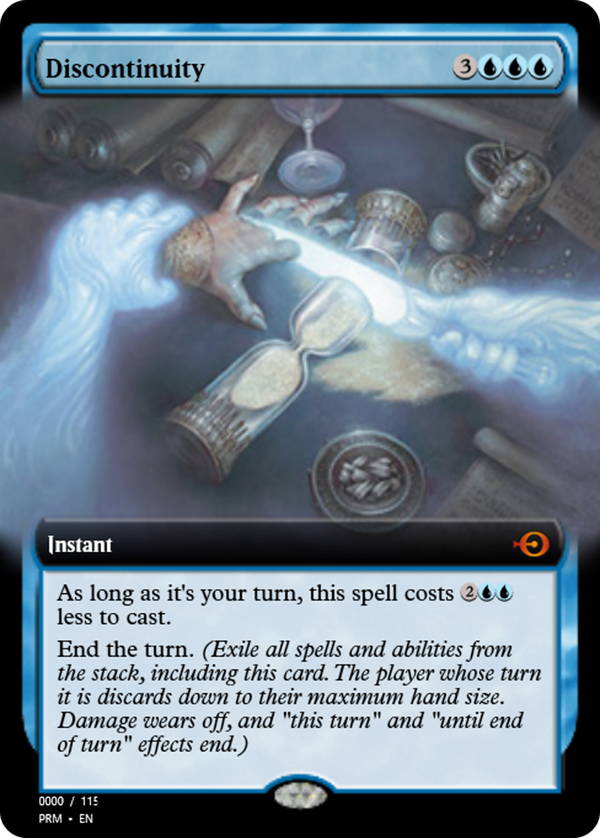
Rules text
less to cast.
End the turn. (Exile all spells and abilities from the stack, including this card. The player whose turn it is discards down to their maximum hand size. Damage wears off, and "this turn" and "until end of turn" effects end.)