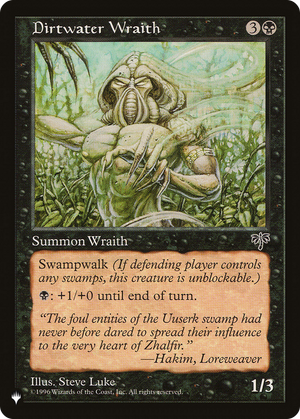
Dirtwater Wraith


A textbook example of the conditional-evasion creature that Mirage built around its dual-land manabase: a body whose entire pitch is that it might be unblockable, against an opponent whose lands you cannot control. Swampwalk pays off only when the defending player happens to control a Swamp, which makes the Wraith a gamble rather than a plan; it is evasion outsourced to your opponent's deckbuilding. The firebreathing line (: +1/+0) is the design's attempt to give that gamble a payoff curve: when the swampwalk does connect, you can dump excess black mana to turn a 1/3 into a real clock, scaling the threat with the late-game flood that black decks tend to accumulate. The toughness of 3 over the power of 1 tells you which half the designers trusted: this is a creature meant to survive to a turn where it can profitably sink mana, not one meant to trade in combat. The whole package belongs to an early-format design language in which landwalk was a load-bearing evasion mechanic rather than a fringe one, before the game settled into the assumption that you should not stake a creature's relevance on the lands your opponent happened to draw.
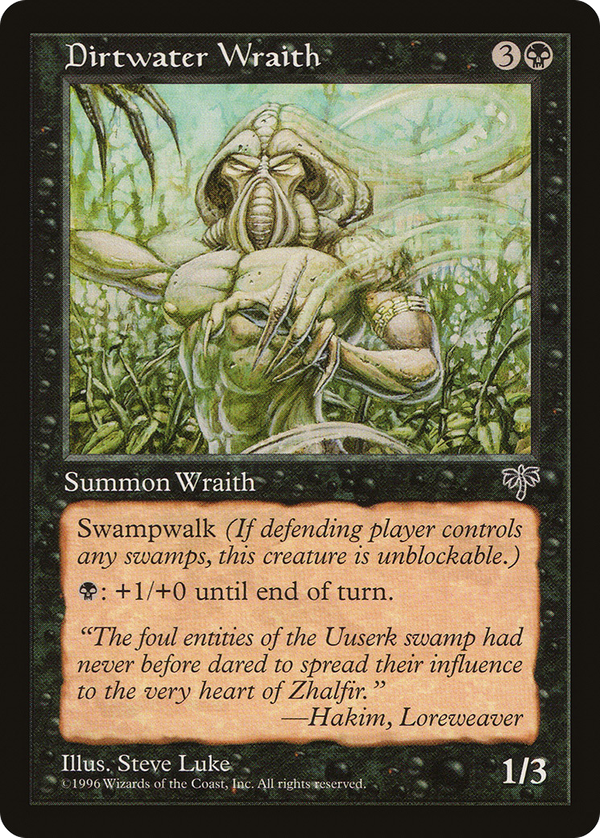
Rules text
: This creature gets +1/+0 until end of turn.