Diminishing Returns


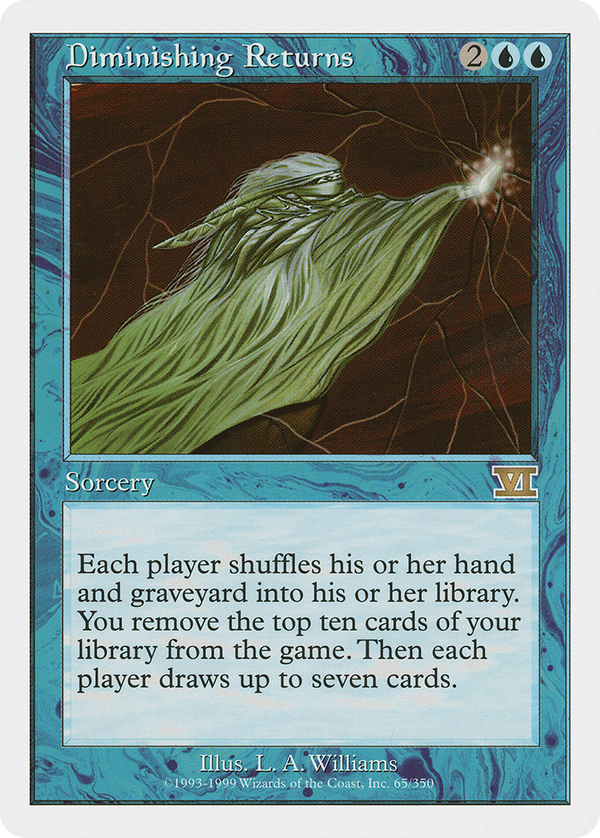
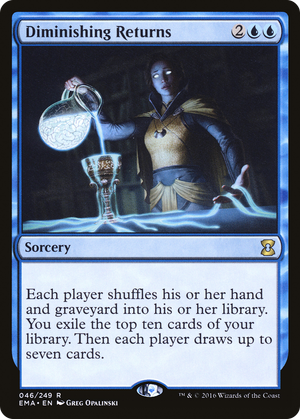
A Wheel of Fortune with a tax built into the cost, and the tax is the whole point. Where the original wheel refilled every hand to seven by emptying and redrawing, this version shuffles each player's hand and graveyard back before the draw, then makes the caster pay a ten-card exile off the top of their own library for the privilege. That exile is the brake: it turns a symmetrical refill into an asymmetrical cost the caster eats alone, a deliberate hedge on a "draw seven" effect the designers clearly did not want to hand out clean. The graveyard-shuffle half does quieter work, denying recursion and reset to anyone leaning on their bin, which makes the card read less as a pure card-advantage engine and more as a disruption piece dressed up as one. The math rarely flatters the person casting it: spend four mana and ten cards to let the table draw up to seven fresh cards, and the symmetry usually helps an opponent more than it helps you. It survives as a curiosity in the lineage of restricted wheels, the cautious answer to a question Wheel of Fortune had already answered recklessly, and a reminder of how nervous early design was about the raw power of mass redraw.