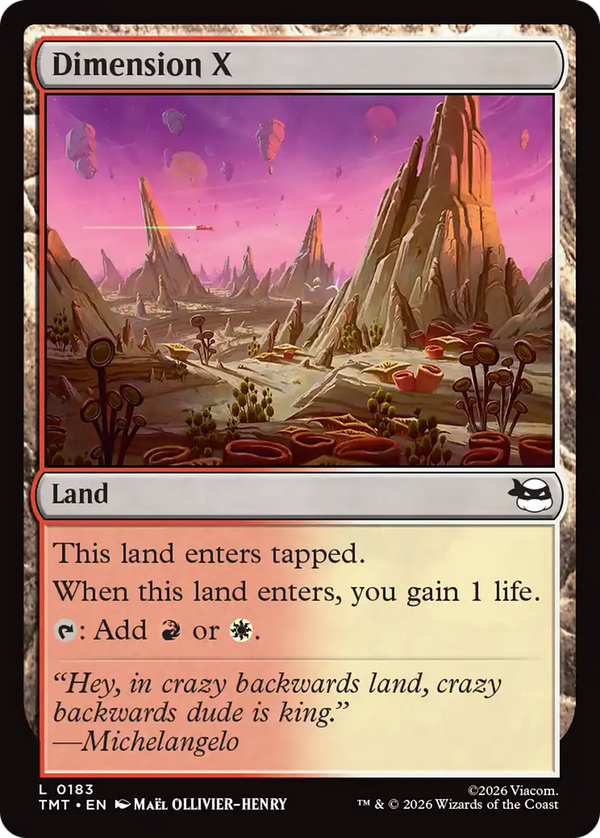
Functionally Wind-Scarred Crag. The interesting question is whether a Refuge climbs or sinks in TMT, and the answer here is that it holds its usual slot: a fine middle pick that maindecks in any deck running both colors, and a perfectly defensible splash enabler given how easily the hybrid commons stretch a base. Fixing in this set is already good, with utility lands at common and hybrid bleed across pairs, so this is not the kind of format where a tapped dual gets bid up out of scarcity. It is also not punished. The set is medium-speed, the bottom of the curve is not racing you, and the life point is real against the Sneak attackers and Equipment beats that define the format's aggressive draws. Boros itself is a real archetype here, and Mardu lifegain splashes are plausible enough that this gets taken out of the middle of packs by more decks than just the two-color RW seat.
Dimension X
How this card plays
Functionally Wind-Scarred Crag. In Commander the Refuge cycle does exactly one thing: it fills a slot in a Boros base for the cost of a tapped land and a point of life that nobody at the table will remember. The format is generous to tapped lands, since the games run long and the early turn you spend untapping it is rarely the turn anything is decided. That generosity is also the ceiling. With Command Tower, Boros bounce lands, the Triome, and a deep bench of untapped duals all competing for the same handful of nonbasic spots, a no-upside tapped dual is the last fixing you add, not the first. The point of life is real and free and does nothing. Take it if your two-color mana needs the source; cut it the moment a cleaner Boros land is available.
Functionally Wind-Scarred Crag, which is itself a strictly-worse Boros tapland than nearly anything Modern has access to. The format already has untapped duals, fastlands, fetch-shock manabases, and the painlands proper for this color pair, so a tapped enter with a single point of life clears no bar the deck cares about. It is legal and has yet to register in tracked tournament play, which is the expected result for a Refuge in a format this fast. Nothing about this printing changes the read: it adds a copy to the pool at a price floor and nothing else.
Functionally Wind-Scarred Crag, the Boros entry in the Refuge cycle. In Standard the read carries over without amendment: a tapped dual with a point of life is the floor of two-color fixing, the source you run because a base needs a tenth land that makes both colors rather than because it does anything. It is legal but has yet to register in tracked tournament play this season, which is the expected outcome for a card at this rate. Standard's manabases reach for lands that come in untapped or do something on the way down, and a Refuge clears neither bar. The point of life is decoration. If a Boros deck ever wants it, it wants it as the budget filler the original always was.
Functionally Wind-Scarred Crag. In Pioneer the question is never whether a tapped Refuge land is good (it is the floor of two-color fixing) but whether anything wants it over the deeper Boros options the format already runs, and nothing does. Between the painlands, the fastlands, and the various dual lands with upside that Pioneer hands red-white decks, a land whose entire ceiling is a point of life and a tapped enter has no seat at the table. It is legal and yet to register in tracked play this season, which is the expected result for a card that competes with strictly better fixing in its own colors. Nothing in this printing changes that.
Registered in 0.4% of tracked decks, 3.8 copies on average, 4 Top 8 finishes. Last seen May 26, 2026.
Functionally Wind-Scarred Crag. In Pauper the question is never whether a Refuge tapland is good in the abstract: it is whether the deck has the patience to take the tapped turn, and the answer is usually no. The format's premium fixing is the dual lands that come in untapped, and the aggressive Boros builds that would want these colors are exactly the decks least willing to give up the tempo. So it lands where every Refuge lands here: a fringe option, run as part of a fixing suite in the slower or splash-heavier white-red builds when the life and the second color outweigh the stumble. It adds a copy to the pool and nothing to the conversation. The decks that wanted Wind-Scarred Crag want this; the many more that don't still don't.
Functionally Wind-Scarred Crag, which tells you the entire story in Vintage: it does nothing here. A tapped Boros dual with a point of life is fixing built for a 40-card deck and budget Standard mana bases, not a format where the lands that matter generate advantage or fix instantly and for free. Legal, but it has yet to register in tracked tournament play, and there is no reason it would. The decks that want red and white in Vintage are already running better untapped sources. This is a Limited and budget card living on a Constructed legality it will never use.
Functionally Wind-Scarred Crag. Legacy is the wrong format for the floor of two-color fixing: a deck running Boros colors here has fetches, duals, and Plateau before it ever considers a tapped land that gives up a turn for a point of life. It is legal, and it has yet to register in tracked play, which is the expected result for a Refuge-cycle land in a format defined by untapped, fetchable mana. The reprint adds a copy to the pool and nothing to the conversation.
Rules text
 : Add
: Add  or
or  .
.