Devastation


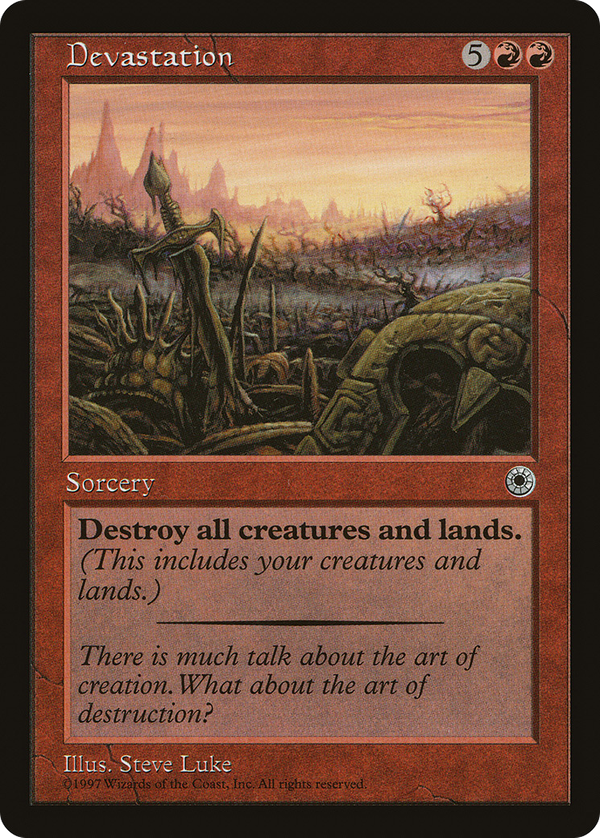
Armageddon was the white scorched-earth statement: wipe every land and let the player ahead on the board collapse the game. This is the red answer to the same question, and it answers by refusing to choose. Where Armageddon leaves the creatures standing, this takes the lands and the bodies together, a total reset of both axes the game is fought on. The design logic is brutally honest about what red believes: if you cannot keep what you have, neither can anyone else, and seven mana is the toll for burning the table to the studs. That symmetry is the whole point. There is no exception clause, no "creatures you control," no asymmetry to engineer around at the cost of elegance; everything that touches dirt or stands on it is gone. The Portal printing accounts for the plain destructive language: a sorcery written for new players, the effect reading as a single sweeping verb rather than a stack of conditional triggers. The cost is the constraint that balances the rate. At seven mana it lands long after the board state it is meant to erase has already formed, so casting it is a confession that you are behind on both fronts at once and willing to start the game over from nothing. It is the maximalist version of the land-destruction philosophy, the card that says quietly that red, given enough mana, would rather salt the earth than lose on it.