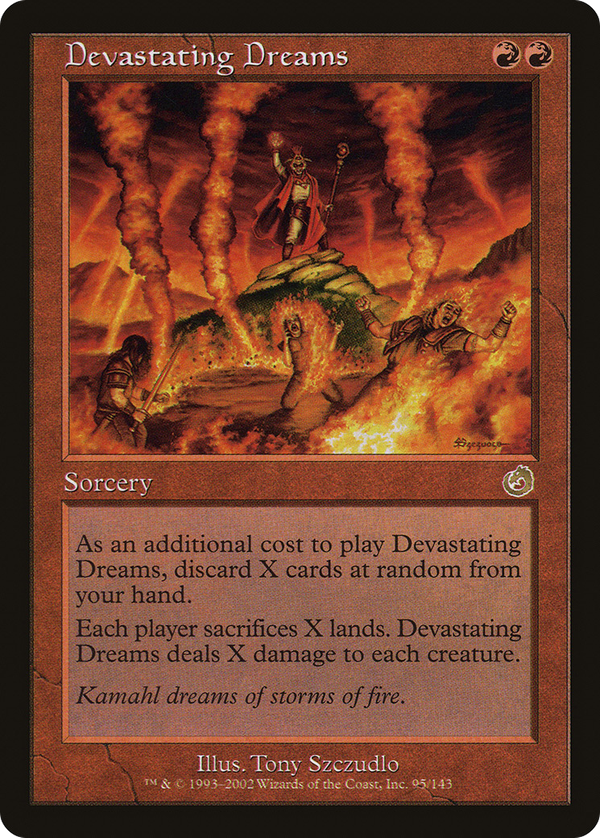
Devastating Dreams

Three resources move at once, and the random discard is the dial that sets the other two. X is not free: you pay it by pitching X cards at random, and only then does the spell raze X lands from every player and rake X damage across every board. That coupling is the design's whole engine. The cost you pay is symmetric to yourself but asymmetric to the table, because you choose the moment. Cast it when your hand is thin and your opponent's board is wide, and you trade a card or two of your own to strip lands and creatures they cannot afford to lose. The size of the catastrophe is exactly the size of the price you were willing to pay, and the random clause means you cannot cherry-pick the cheapest cards to feed it: a greedy X risks discarding something you wanted. So the spell punishes hoarding on both ends. Hold a full grip and you have the fuel for a huge reset but the most to lose to the randomness; run lean and the spell shrinks toward irrelevance. The sweet spot is a deliberately emptied hand with a few expendable cards left over, which is a narrow window and a real cost, not a loophole. It is a red answer to the problem of breaking a parity effect: the spell hits everyone equally, so you arrange to be the player least hurt by it before you cast.