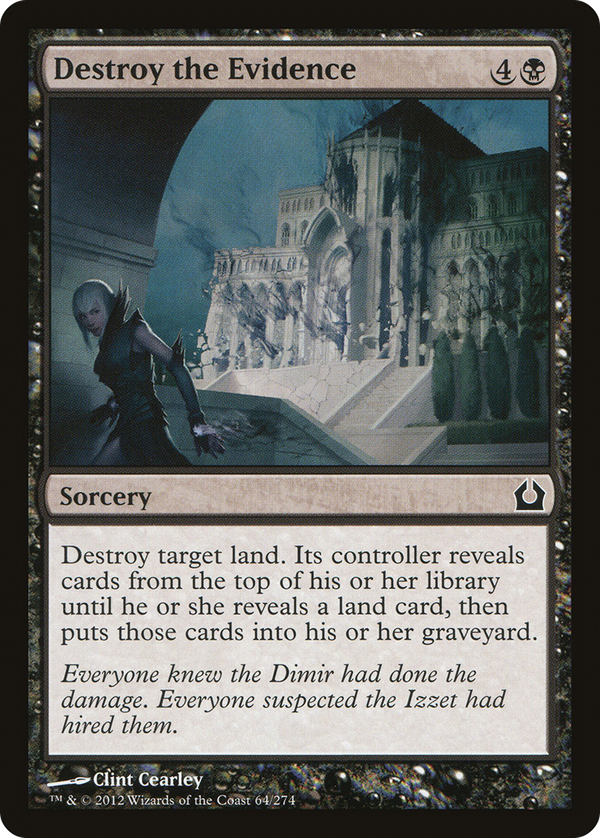
Destroy the Evidence


Land destruction has always been priced like a tax, and the unglamorous half of that bill is mana value: spending five to blow up one land usually loses you the game on tempo alone. This is the design that tries to make the rate palatable by attaching a payload to the destruction. The mill clause is dependent rather than fixed: it eats cards until it hits another land, so against a heavy-land manabase it whiffs into the graveyard quickly, while against a deck running few lands it can strip a real chunk off the top. That variance is the whole bargain. You are not paying five to set an opponent back one land; you are paying five to set them back one land plus whatever their library decides to surrender, and the more spell-dense the deck you point it at, the more it bites. The structural cousin here is the milling end of black's library attrition rather than the Stone Rain school of pure resource denial, which makes it an awkward fit for the decks that actually want land destruction (control and ramp) and a slightly better one for the decks that already care about filling a graveyard. It is land destruction reframed as incidental disruption, and whether that reframing is worth a card depends entirely on whose deck is on the receiving end.