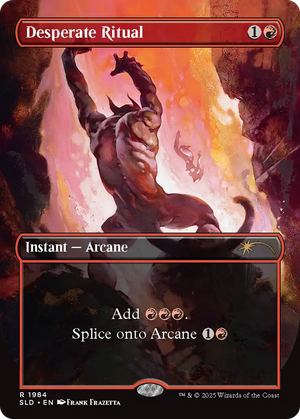
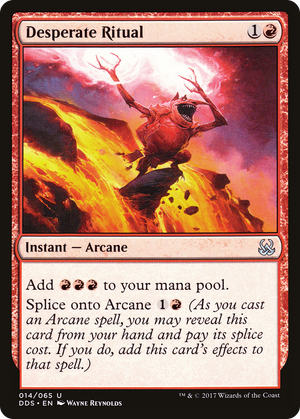
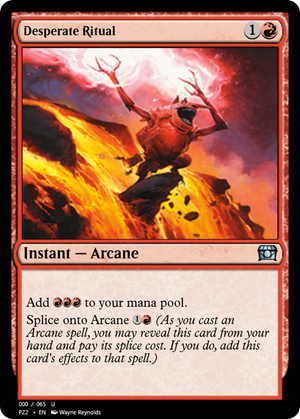
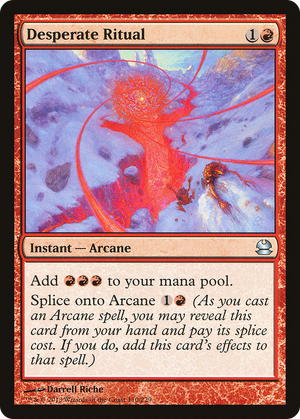
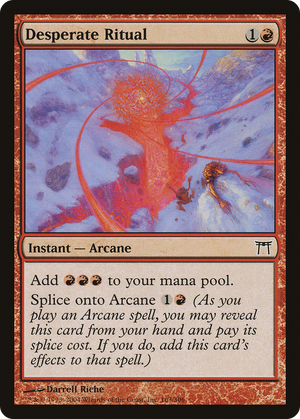
Desperate Ritual


Cast face-up, this is the most marginal acceleration imaginable: pay two mana, get three, a single-mana profit nobody builds a deck around. The reason it matters lives in the splice line, which inverts how you read a ritual entirely. Splice onto Arcane is a static ability rather than a trigger: when another Arcane spell goes on the stack, you reveal this from hand, pay , and graft its into that spell's resolution without spending a separate cast. The same physical card can splice again and again across a turn so long as you keep paying, which is how a hand of cheap Arcane spells turns into a sudden flood of red mana out of nowhere. That structural trick (one card generating mana every time another Arcane spell resolves) is the engine behind storm-style combos that lean on cost reduction and critical mass. The front face is the floor; the splice line is the ceiling, and the gap is where the card earns its place. The splice mode also softens the usual ritual liability against interaction. A standalone ritual fed to the stack is gone if it gets countered; a spliced one is never on the stack at all, so when control answers the host spell, this stays in your hand for the next attempt rather than burning with the play that drew the answer.
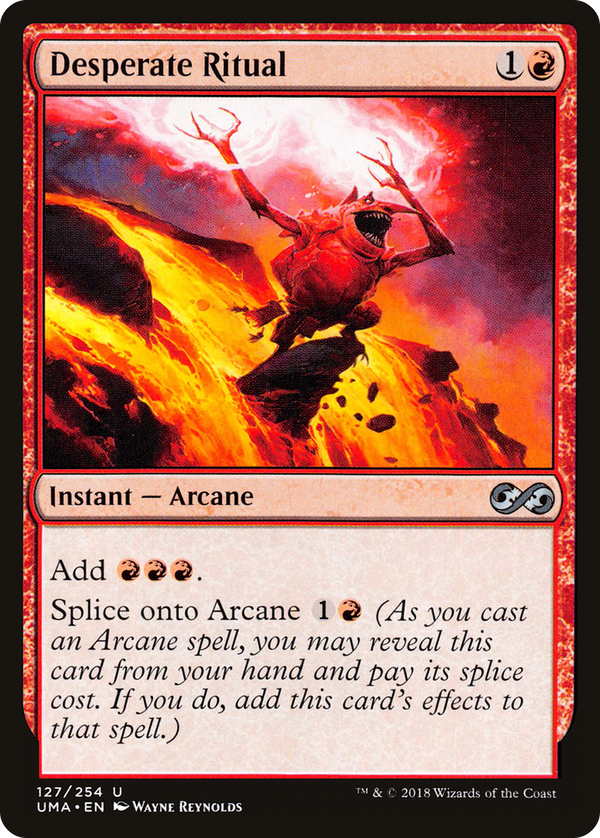
Rules text
.
Splice onto Arcane (As you cast an Arcane spell, you may reveal this card from your hand and pay its splice cost. If you do, add this card's effects to that spell.)