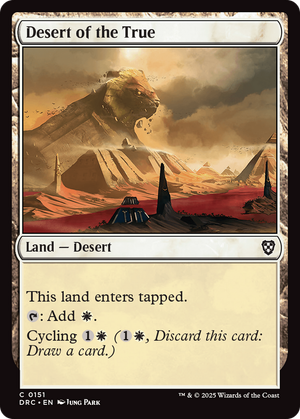
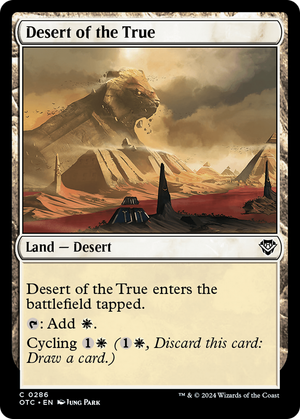
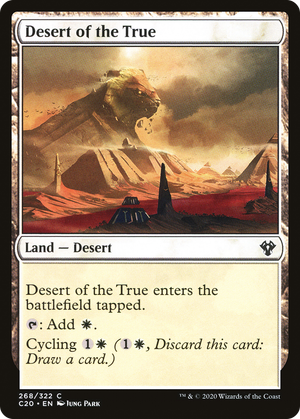
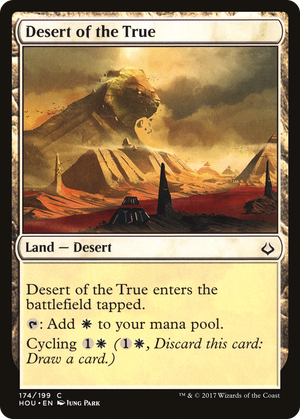
Desert of the True
The dead land in the late game is the oldest tax in deckbuilding: the source you needed on turn two becomes a wasted draw on turn nine, and there is no way to spend it. This cycle answered that by folding two cards into one. Early, it is a slow white source that comes in tapped; late, you pitch it for a fresh card at instant speed. The same piece of cardboard plays the role the game state asks for, and you never have to decide at deckbuilding time which one you wanted. The pricing is what keeps the trick honest. Entering tapped is the front-end cost of carrying a spell stapled to a land, and the 
 cycling fee means the late-game pivot is paid for, not free. Just as important is what the card deliberately does not do: it produces only white and carries the Desert subtype rather than a dual mana base, because a fixer that also cantripped on demand would have been a better tapland than any white deck had ever run, with no downside to justify it. The narrower the mana, the more defensible the cantrip. What the design really sells is the manabase as a hedge against variance instead of a pure resource: you run a land knowing its worst outcome (a turn spent untapping a Plains-equivalent) is also its escape hatch (a card off the top), and you let the board decide which version you drew.
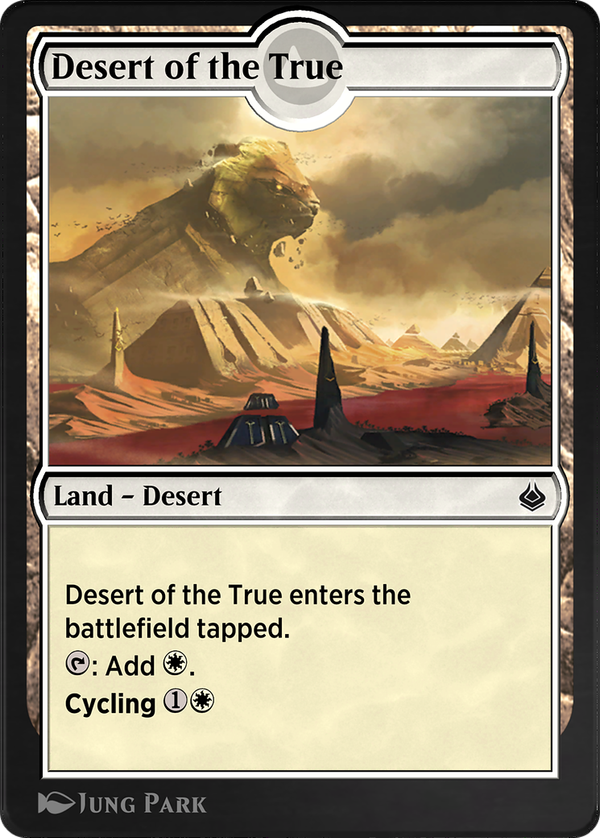
Rules text
 : Add .
Cycling (, Discard this card: Draw a card.)
: Add .
Cycling (, Discard this card: Draw a card.)