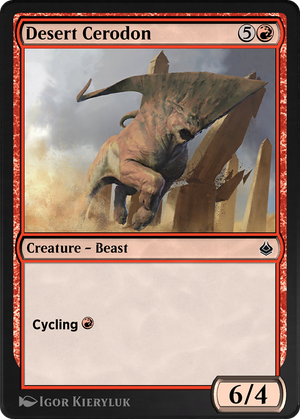
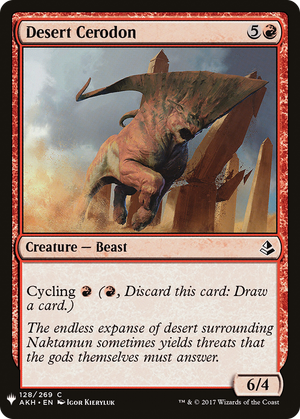
Desert Cerodon


Six mana for a 6/4 with no evasion and no enters-the-battlefield payoff is a body that rarely earns a deck slot on its merits, and the design is built around that fact. The cycling cost is the actual product: for a single red, the creature stops being clunky top-end and becomes a fresh card, fixing a hand that came up land-light or spell-heavy. The split-purpose math is what keeps the card playable on both ends. Early, when you have one or two lands and no use for a six-drop, you turn it into a new draw and keep your action live. Later, when you have the mana and want pressure, you cast a 6/4 that trades up on the ground or races a stalled board. The four toughness is the limiting wrinkle that makes the cheap cycling easy to reach for: a body this fragile (it dies to most burn and loses plenty of combats) is one you are seldom sad to have converted into a card instead of a creature. This is the cheap-cycling fatty pattern that smooths a curve by giving a high-cost beater an early-game exit valve. The body is the floor; the red-mana cycling is the part you are really buying, and it is the part that determines whether the card ever sees the table.
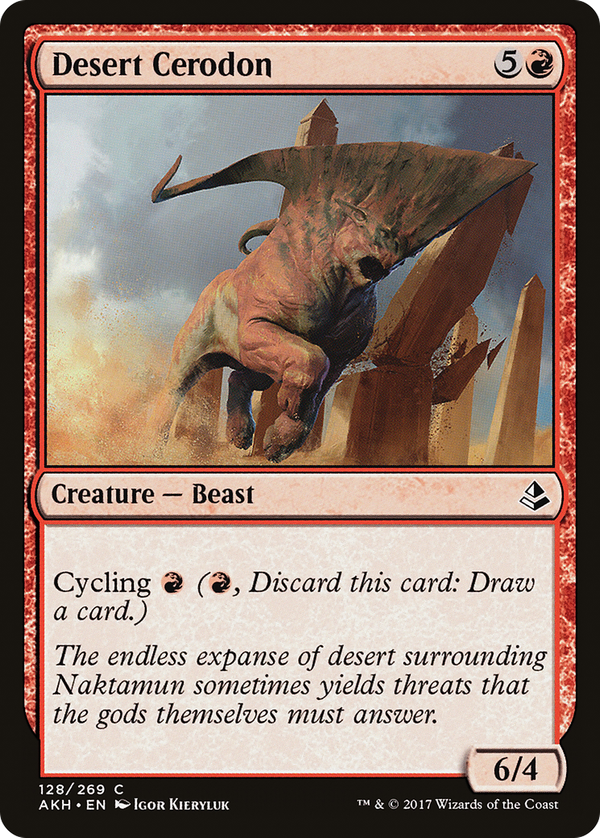
Rules text
(, Discard this card: Draw a card.)