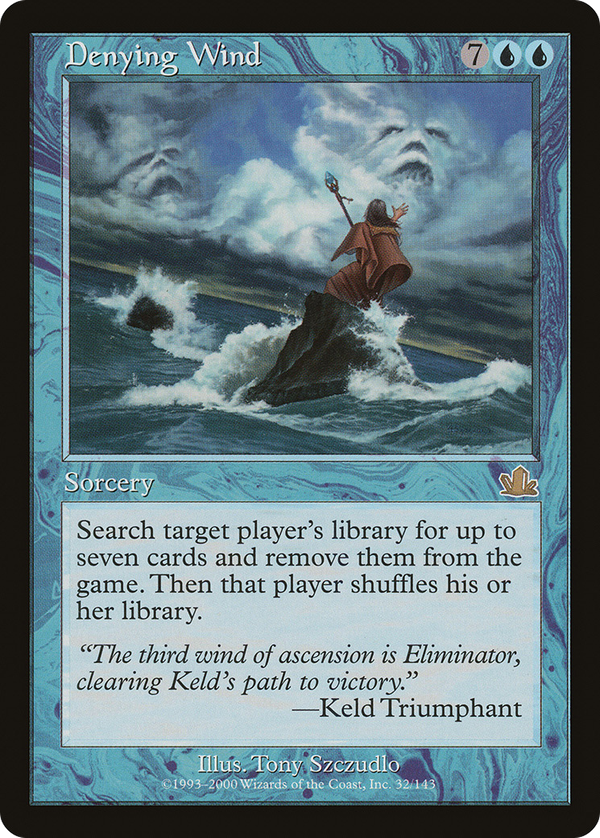
Denying Wind


Nine mana at sorcery speed to reach into an opponent's library and exile the seven cards you least want them to draw: this is mill's surgical cousin, attacking the deck not from the top but from anywhere in it. Because you search rather than strip a fixed spot, the effect is precise on paper. You can name a combo, hunt both halves out of the library, exile them, and force the shuffle that papers over the wound. The toolbox-hate fantasy is the whole design intent: leave the deck unable to win because the cards that won are gone. The trouble is never the precision; it is the price. Nine mana buys a single sorcery-speed turn that arrives long after the format has decided whether the opponent already drew what mattered, and a sixty-card library is rarely so brittle that removing seven of its best cards severs every line: the deck still has redundancy, still has lands, still has a turn to rebuild while the shuffle hands play back. The card reads as oppressive and plays as ceremonial, a relic of the turn-of-the-millennium blue instinct to price the fantasy of complete denial rather than the reality of the turn it actually resolves on. The text promises a total lock; the cost guarantees that lock almost never assembles inside a real game clock.