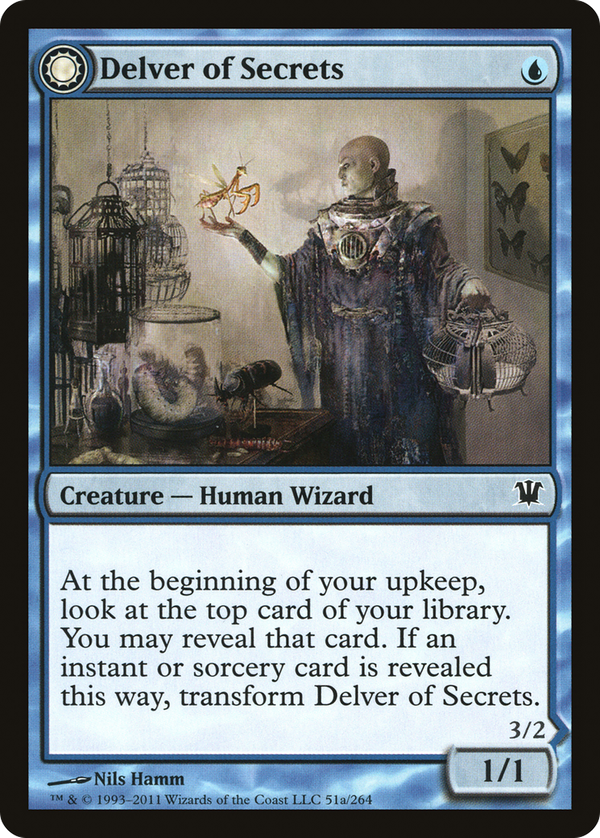
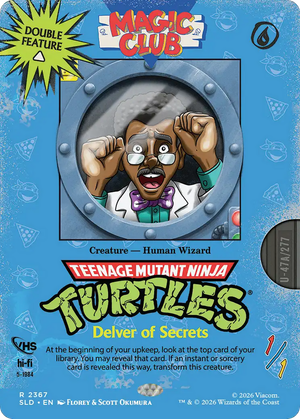
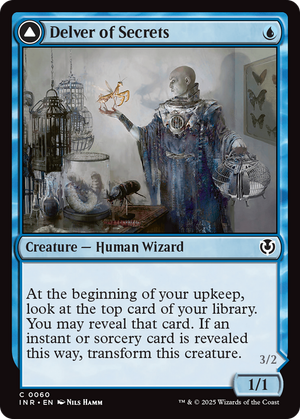
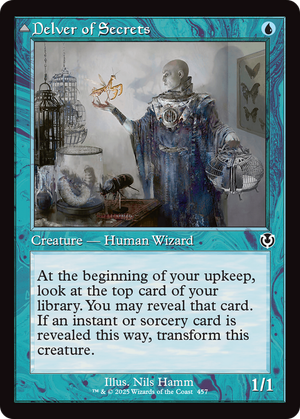
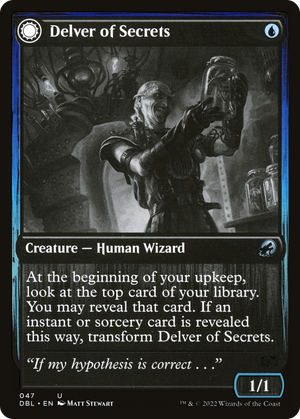
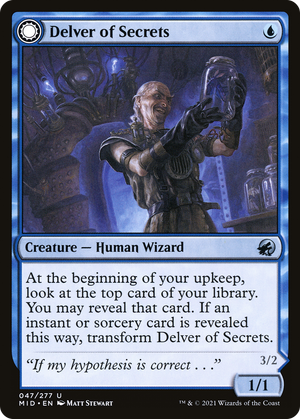
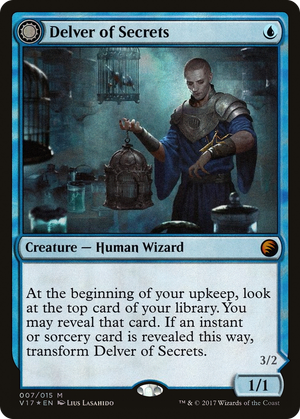
Delver of Secrets // Insectile Aberration
The deal is plain: pay one mana for a 1/1, then ask your library to keep your spell count honest. Reveal an instant or sorcery on your upkeep and the body flips into a 3/2 flier; miss and you have a one-drop that keeps peeking at the top of your deck each turn, hoping the count comes good. That gamble is the entire engine, and it rewired how tempo players thought about deck construction. A spell density that would be reckless elsewhere becomes mandatory here: every land and creature you add lowers the flip odds, so the threat's effective size is dictated by what surrounds it. The transform happens on your own upkeep and looks before you draw, which means a fetchland, a scry, or a Brainstorm on the prior turn is not just card selection: it stacks the trigger. That feedback loop (cantrips fuel the threat, the threat clocks while the cantrips dig for answers) defined a whole school of tempo, the kind that wins behind a single evasive body and a fistful of cheap interaction. The catch is intentional: a flipped Aberration is a fragile 3/2, alive only as long as nobody points removal or a larger flier at it. Even a stalled flip never wastes the look; it hands you free information about your next draw, and the evasive threat it eventually becomes is exactly the thing that breaks a clogged ground board. Few creatures pay for their power so completely with the deck they demand you build.