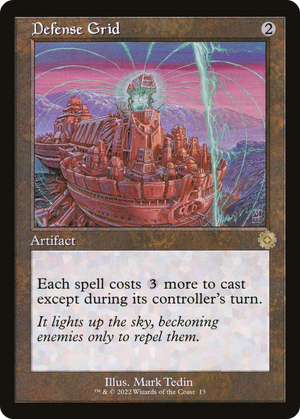
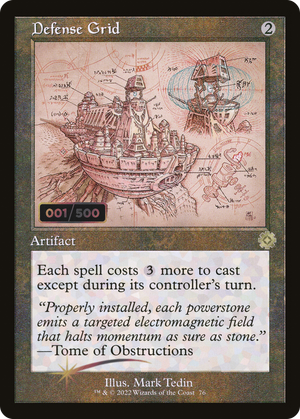
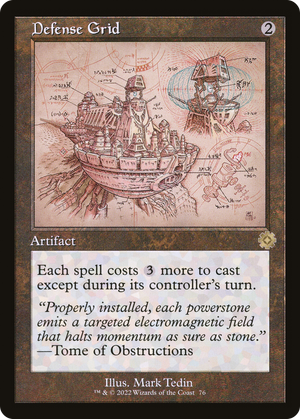
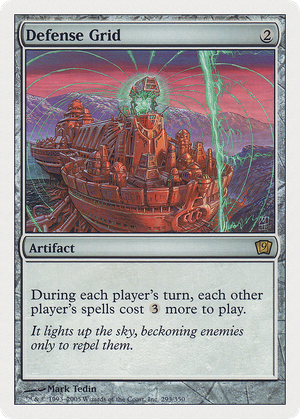
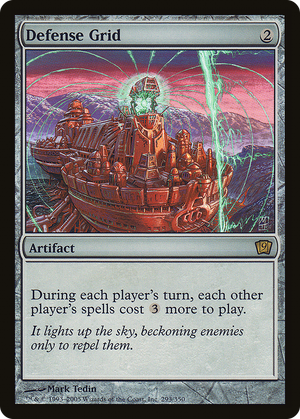
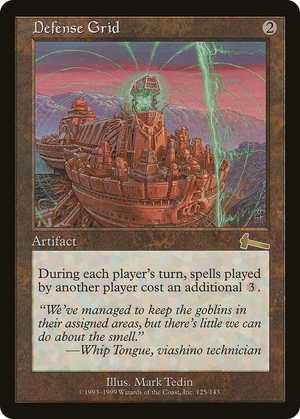
Defense Grid

The tax reads as symmetrical (it says "each spell"), but the timing exemption is what turns that symmetry into a weapon for one side. Because the surcharge lifts during the caster's own turn, the player who built around the card acts for free while the opponent must find three extra mana to interact. The effect targets the stack, not the board: it does not stop a counterspell or a removal spell, it prices them out of the window where they would actually matter. An opponent holding up a counter on your end step now has to budget three more, and a player who wanted to flash in a blocker or fire off instant-speed disruption during your turn is taxed into silence. The honest part is that the surcharge falls on you too whenever you try to cast something on someone else's turn, so the card is not a one-sided lock that leaves its controller free; it is a deliberate trade that says the game happens when it is your turn to act and nobody else's. That single timing clause is what keeps it balanced, and it is also what defines the constituency: proactive, combo-forward decks that want to resolve a fragile, telegraphed sequence without leaving room for a response. Less a hate card than a manifesto about whose turn the important spells get cast on, it has aged into a quiet specialist precisely because the player it serves is a narrow but enduring one.
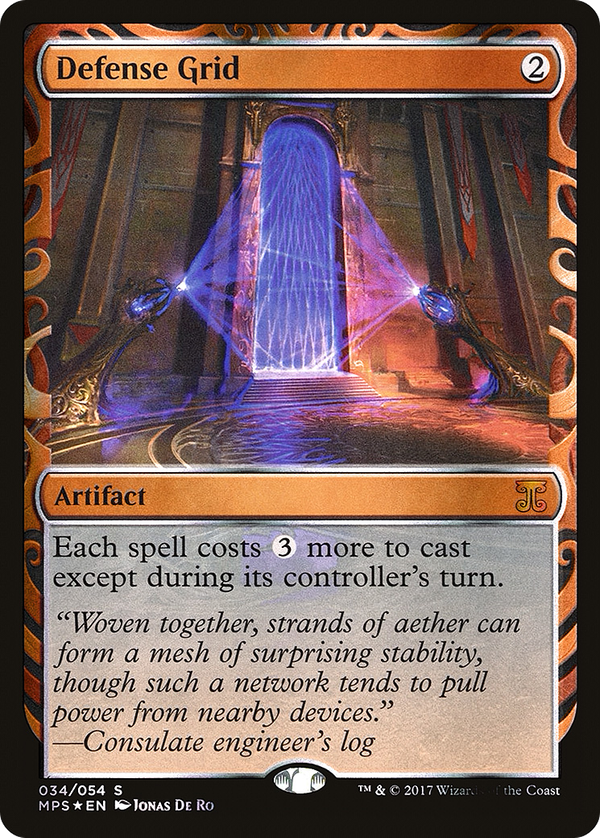
Rules text
 more to cast except during its controller's turn.
Format Status
More formatsFewer formats
Other printings
- The Brothers' War Retro Artifacts#13
- The Brothers' War Retro Artifacts#76z
- The Brothers' War Retro Artifacts#76
- Ninth Edition#293
- Ninth Edition#293★
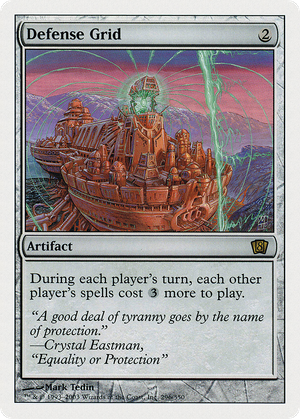
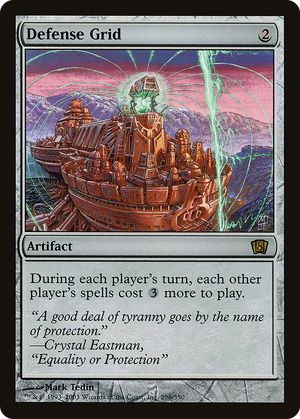
- Eighth Edition#296
- Eighth Edition#296★
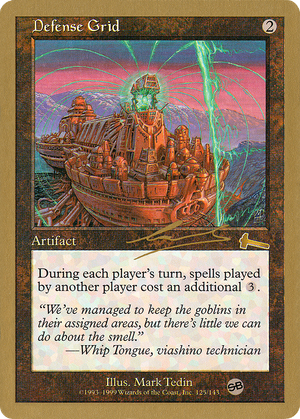
- World Championship Decks 2000#nl125sb