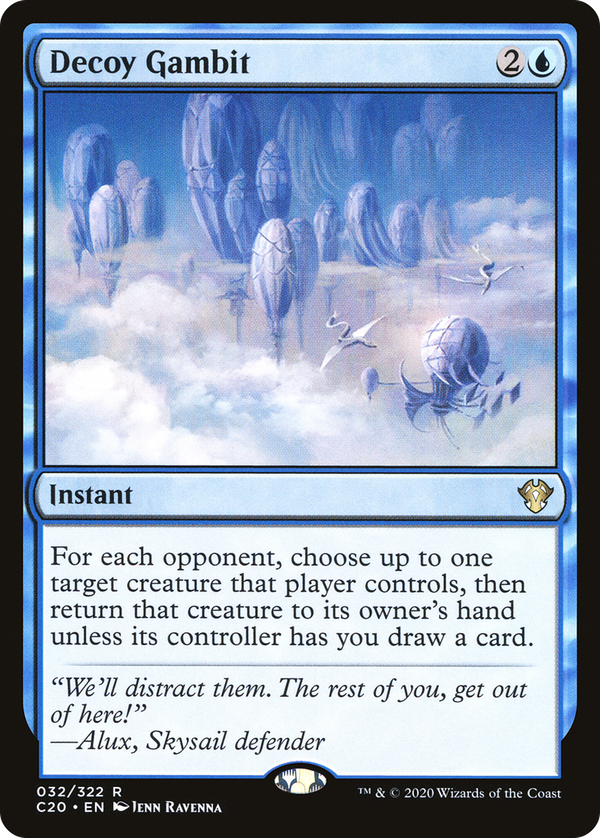
Decoy Gambit


The gambit lives in the second half of its own sentence. Each opponent you point at gets a binary offer: let the creature bounce, or hand you a card to keep it. That "unless its controller has you draw a card" clause is what turns a mediocre Boomerang into a table-wide negotiation, and it hands the choice to the defender rather than the caster. This is a design that only works with multiple opponents feeding it: against a single player it is an overpriced tempo trick, but scale the opponent count up and it becomes a rare effect where you profit no matter which way each player jumps. Bounce a threat back to a hand that has to spend a turn redeploying it, or refill your own grip while your opponents keep their boards; the cards you draw are the consolation prize your opponents choose to pay rather than lose tempo. The elegance is that no single opponent is forced into the worst outcome, which keeps it from feeling like pure oppression, yet you skim value off the whole pod at once. It belongs to a small family of instants built explicitly for the free-for-all: effects whose math only balances when the "each opponent" clause has three targets to work on instead of one. Read as a duel card it looks underpowered; read as what it is, a group-scaled tempo-and-card engine, the rate makes sense.