Decompose


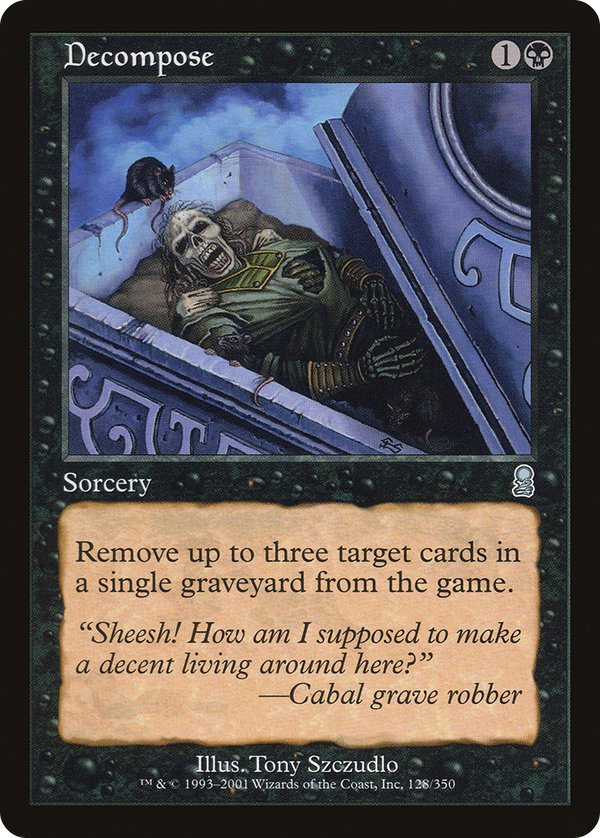
Graveyard hate built as a scalpel rather than a hammer, pointed at a moment when the graveyard had stopped being a junk pile and become deliberate fuel. When a stocked graveyard turns into a permanent upgrade across an entire deck, a blanket exile-everything answer is clumsy and self-punishing: it does nothing when the yard is small, and it overpays when only two or three cards actually matter. Pinpoint exile of up to three cards from a single graveyard is the right shape for that fight. You strip the recursion target, the flashback spell, the cards padding a threshold count, and you leave the rest. The constraints are what keep it from being a catch-all. The single-graveyard cap means it cannot police a multiplayer table at once, and the sorcery speed means it lands proactively on your own turn rather than disrupting anything mid-combo: cast it during your main phase to clear sorcery-speed flashback spells before an opponent can use them, but understand it cannot stop an instant-speed flashback spell from being cast in response to its own targeting. So it answers a deck built around its own dead cards, not everything that touches a graveyard. That narrowness is why it reads as a product of its era: a black removal spell aimed not at creatures but at the graveyard economy a whole block was trying to sell as a resource.