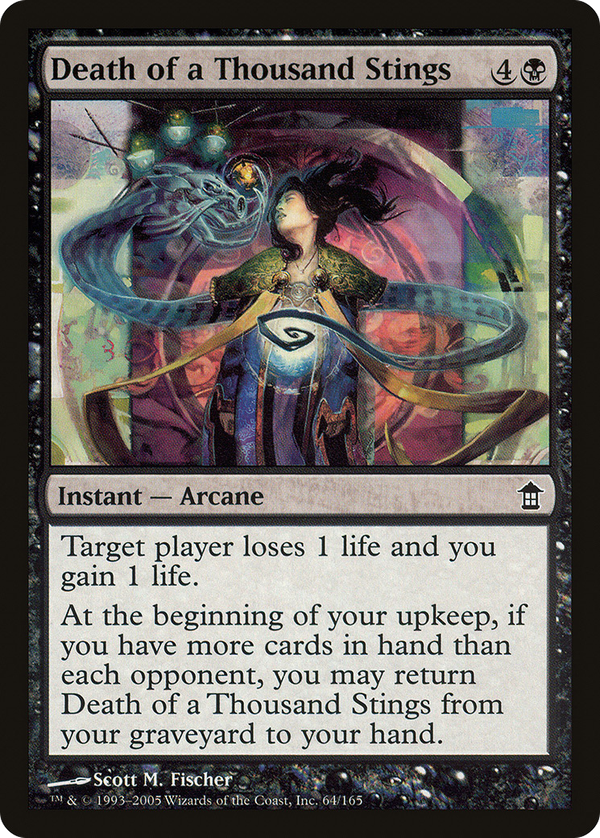
Death of a Thousand Stings


The recursion clause is the entire point, and it ties the card to a deckbuilding posture rather than to the moment you cast it: this returns only if you are out-carding every opponent at the top of your turn. That makes it a drain effect built for a control or attrition shell that already wants to bury opponents under raw card advantage. Five mana to siphon a single point of life is a deliberately feeble rate, an effect that would be laughable as a one-shot; the design pays for the meager drain by making it potentially repeatable, conditional on a state most decks never reliably reach. The Arcane subtype turns it into a host rather than a passenger: a small, recurring spell that splice cards were designed to bolt extra effects onto, so each cast of the loop could carry whatever rider you stapled on for the turn. The name promises death by a thousand small cuts, and the structure delivers exactly that drip: a slow inevitability engine that only fires when you are already ahead on cards. Standing alone it asks more than it gives, but the loop it sketches reads less like a removal spell and more like a wincon for the patient deck that has won the resource war and just needs a clock that cannot be answered.