Deal Broker

The face-up draft clause is doing something the looter body wouldn't suggest: this is a card that negotiates. The  draw-then-discard ability is genuine but secondary, a Merfolk Looter effect stapled to a 2/3 that happens to also fix your card pool before the deck is even built. The real ingenuity is the trade clause, which turns drafting from a solitary information game into an open market. By drafting it face up, you announce that you hold a bargaining chip, and immediately after the draft you can put one of your cards on the table and let every other drafter offer a card from their pool to acquire it. You accept at most one offer. That single line does something almost no other card in the game attempts: it makes the players around the table a literal exchange, with all the bluffing, hate-trading, and value asymmetry that implies. The construction is careful about scope: you reveal one card, others offer one each, you accept one at most, so the negotiation cannot spiral into a free-for-all. It belongs to a rare kind of design built to manipulate the drafting process itself rather than the game of Magic that follows, and the looter reads almost as an apology for a headline ability that only functions in that pre-game window. The 2/3 artifact body is the price of admission; the deal is the card.
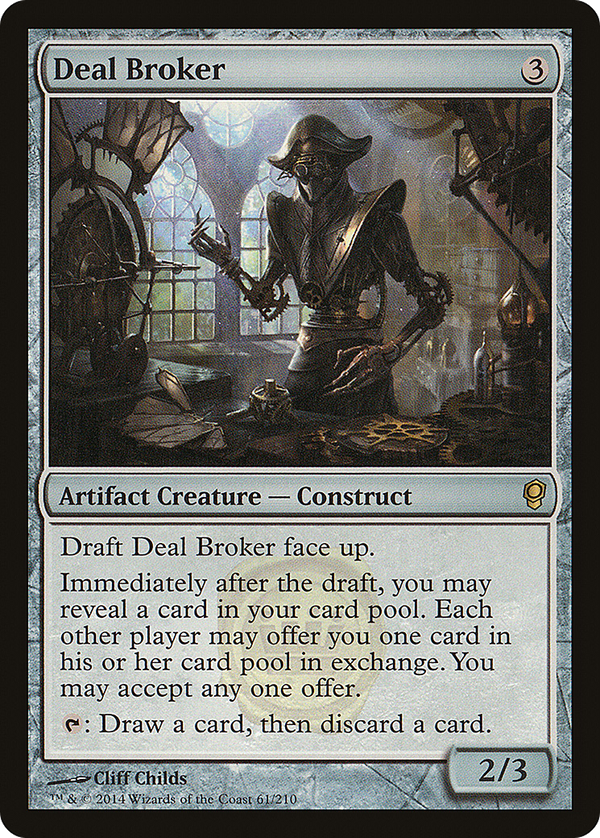
Rules text
: Draw a card, then discard a card.