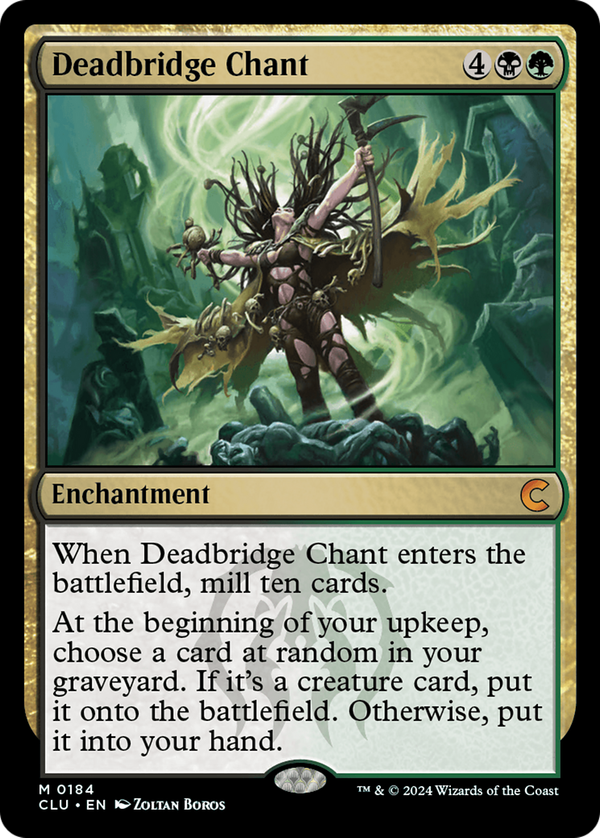
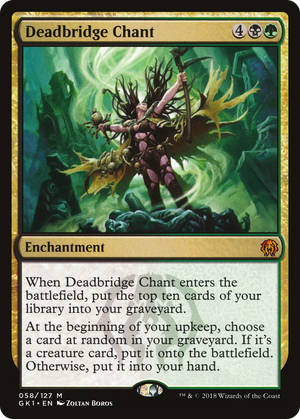
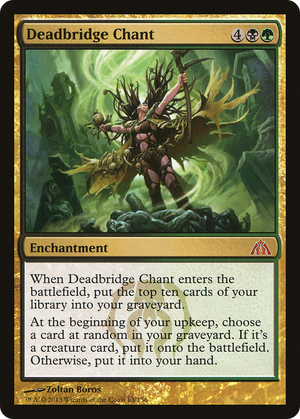
Deadbridge Chant



The randomness is the whole point, and it cuts in both directions. Most graveyard-recursion engines hand you control: you choose what comes back, you sequence it, you build around a single payoff. This one refuses that comfort. It buries ten cards on entry, then every upkeep reaches into the pile blind and pulls one out: creatures walk straight onto the battlefield, everything else lands in your hand. You are not selecting the value, you are seeding the pool and trusting the math, which reframes the deckbuilding problem entirely. A graveyard stuffed with high-impact creatures makes the random pull a reanimation lottery you want to keep spinning; a deck that needs specific noncreature answers gets a coin flip every turn. The self-mill on entry is both the fuel and the risk, since it can pitch a card you would rather have drawn into the same pool you are now sifting at random. As a recursion design it sits closer to a slow, repeating Animate Dead than to a tutor: the engine never stops grinding once it resolves, but it never promises the right card at the right time. That tension between an unbounded value loop and zero selection is what gives it character. It rewards a graveyard built to be good no matter which card surfaces, and it punishes decks that treat the yard as a toolbox with a specific answer waiting to be found.