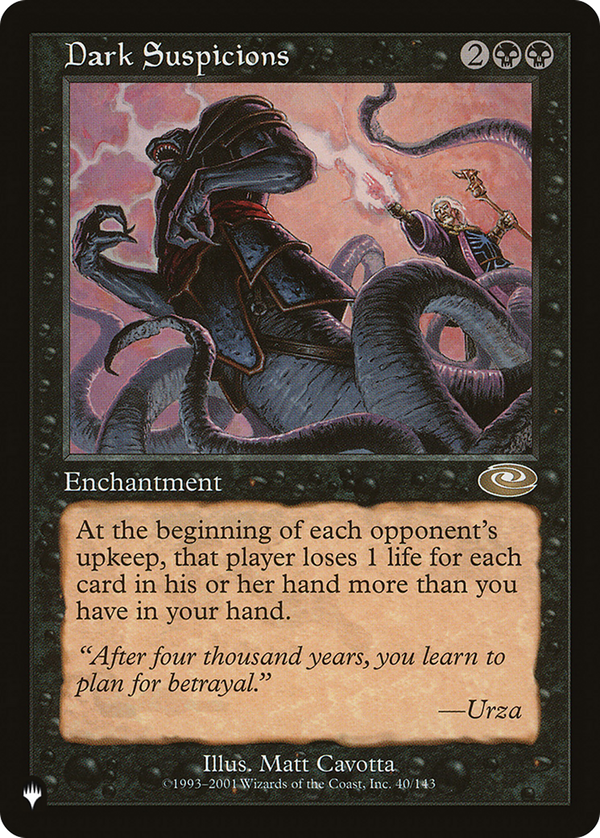
Dark Suspicions


Hellbent as a deckbuilding constraint, years before the keyword existed to name it. The drain scales off the gap between your opponent's hand and yours, which means the enchantment is only at full strength when you are empty-handed and they are loaded: an upside-down resource model where the player sitting on cards is the one being punished. The natural shell, then, is black aggro-discard that dumps its own hand early and applies pressure while the opponent is forced to hold cards, since every card they draw and keep widens the differential and ticks up the bleed. The wrinkle is that the math runs both ways. Anything that shrinks the opponent's hand, including making them discard, reduces the life loss; you do not want to empty their hand, you want them stuck holding it. And the moment they start casting spells, developing their board, the gap closes on its own. That reframes the so-called dilemma: the opponent's path out of the bleed is simply to play the game, to spend cards, which is exactly what a tempo-starved hand wants to do anyway. The enchantment's truest partner is your own restraint on the resource axis: keep your own hand near zero, force theirs to stay high. It converts hand size, normally a passive measure of safety, into an active liability, and it asks the pilot to play in a way most black decks of its era were not built to.