Dandân

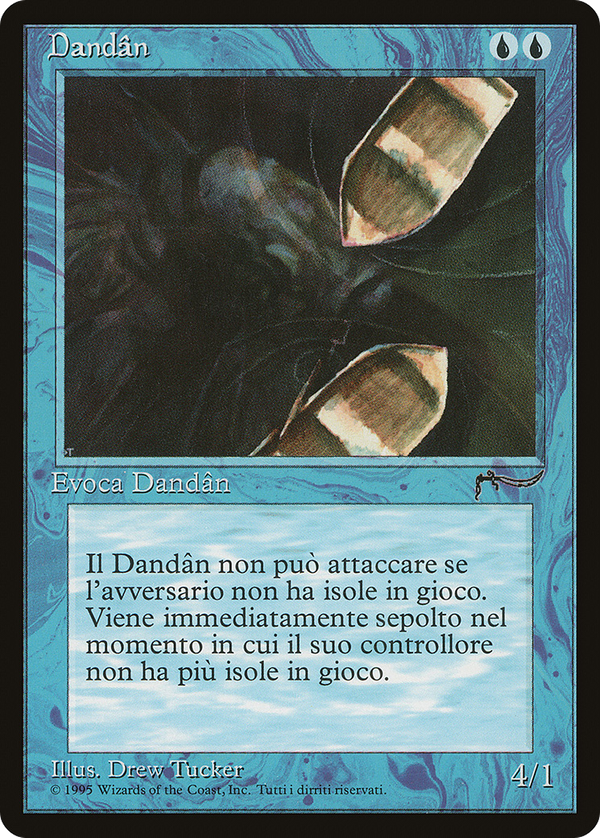
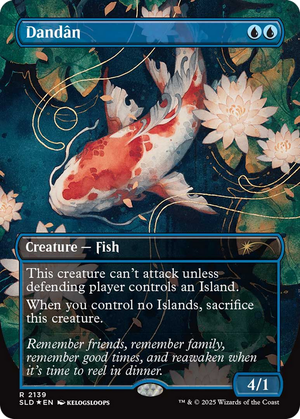
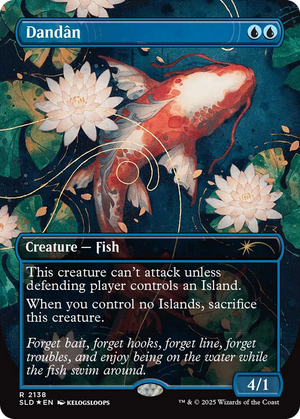
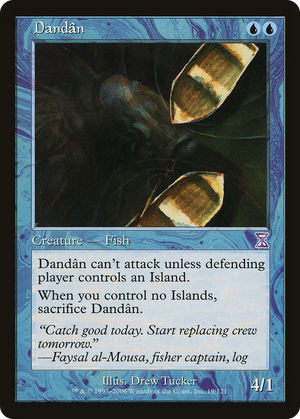
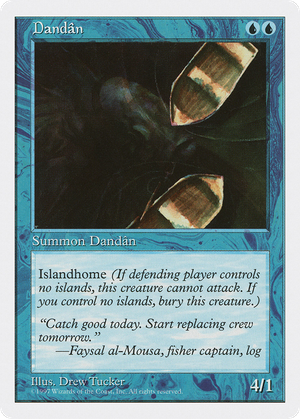
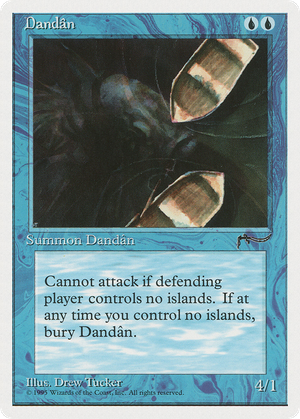
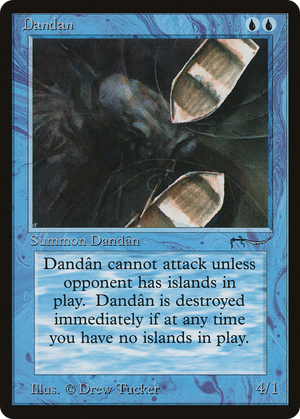
A 4/1 for two mana was an absurd rate in 1993, and the design pays for it entirely in two clauses: the body can only attack when the defending player controls an Island, and the moment you control no Islands yourself, it dies. The attack restriction renders the creature almost ornamental against any opponent who controls no Island, and the self-sacrifice clause means a single land-destruction effect can end it before it does any work. Those constraints, written to tie the creature's relevance to the manabase each player has built, are what make the rate legible: the body is huge precisely because the opening to use it is so narrow. Decades later, players turned those same restrictions into a closed-loop two-player game built around mirrored decks of mostly Dandâns and Islands, racing into the line the oracle text encodes; the format borrows its name from the card. That community puzzle is downstream of the design, not the design's intent. What the original printing actually represents is an early case of a creature whose power level resolves only against a specific kind of opponent: an island-controlling one. Most of Magic's vocabulary assumes a card has to function across an open metagame. This one was tuned to a single axis of the manabase, and the result reads as a deliberate experiment in how much a body can be worth when its window is drawn this tight.