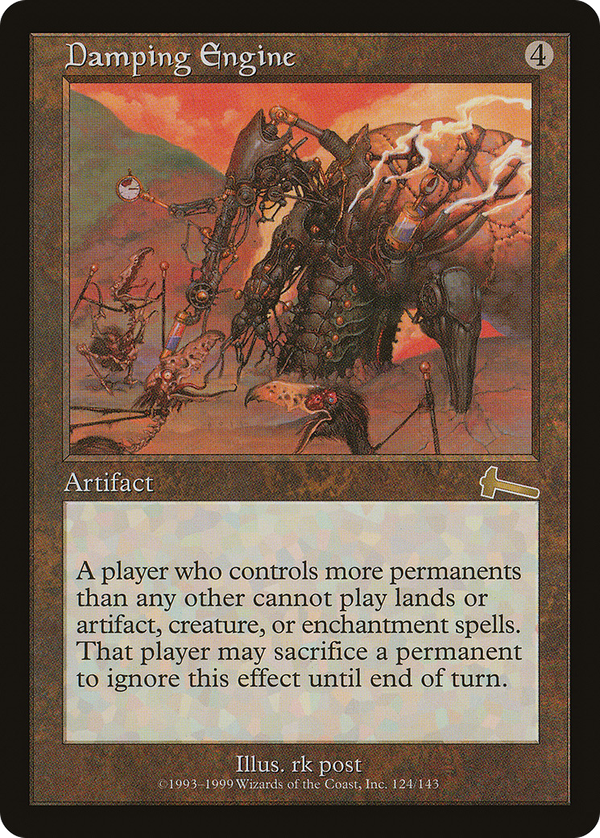
Damping Engine

The design conceit here is symmetry punishing whoever is winning the board, but the punishment lands on a softer target than most catch-up cards of its era. Rather than wiping permanents or taxing spells, it freezes the player with the most permanents out of nearly every meaningful action: no lands, no creatures, no artifacts, no enchantments, leaving only the spell types the restriction doesn't name to keep them company. The escape hatch is what gives it teeth as a design exercise: that player can sacrifice a permanent of their own to ignore the effect until end of turn, which means the leader bleeds board presence every turn they want to develop. It is a feedback loop dressed as a static effect, dragging the runaway player back toward the pack one sacrifice at a time. The Urza's block was full of these big-knob symmetry pieces that asked the table to think about parity rather than damage, and the card commits to that idea bluntly: a permanent count is a crude proxy for "who is ahead," but it is a legible one, applied without exceptions or carve-outs. The friction is that the count flips constantly, so the lock attaches and releases as the board shifts, making it as much a pace-of-game governor as a true prison. A control piece for a multiplayer politics the era was only beginning to formalize.