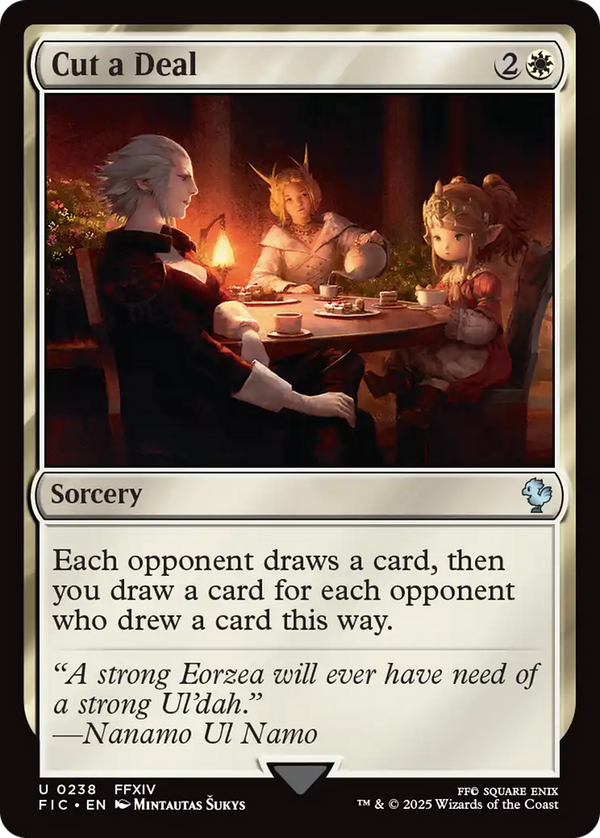
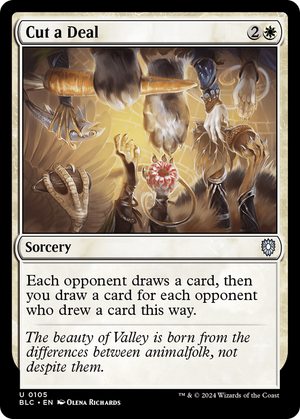
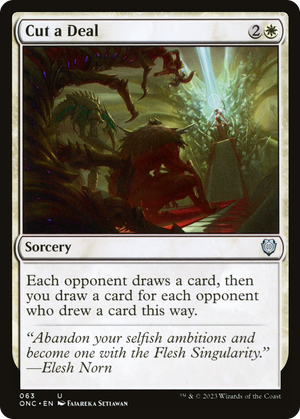
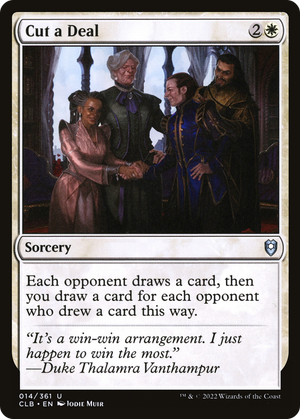
Cut a Deal


Group-hug card advantage with the math quietly tilted in your favor, built around the sequencing baked into the wording: opponents draw first, and only then do you draw one card for each opponent who actually drew. Against a table of three, that hands out three cards and collects three back, breaking even on raw parity while netting you a card of tempo relative to any single player. That is a real trick to pull off in white, a color that has historically had to grind for cards while blue and black cantrip freely. The return climbs as the pod grows: every additional opponent who draws adds one card to your side, which is precisely the axis one-for-one cantrips ignore. It also functions as a peace offering with teeth, buying goodwill (everyone likes free cards) while refilling your own hand under cover of generosity. The "each opponent who drew a card this way" clause does quiet work too, counting only players who genuinely drew: an empty library, or a replacement effect that eats the draw, trims your payout by exactly one card apiece. That conditional payout is what keeps the symmetry from becoming a giveaway, and the reason the card reads generous while working as a self-serving refill for a color never structurally built to have wheel-adjacent effects.