Customs Depot


Tie the looting to your creature count and you get a filtering engine that scales with exactly the deck it was built for: the more bodies you cast, the more often you smooth your draw. Each creature spell opens a window where you can pay the extra mana, fix your hand, and bin the dead card, but never for free. That recurring payment is the pressure valve; you only loot as much as your remaining mana and your creature density allow, which keeps an enchantment that triggers off your normal game plan from ever spiraling. The draw-then-discard ordering is the load-bearing piece in a period when reanimation and graveyard payoffs were a live concern: you can pitch a fatty or a recursion target while keeping a functional hand, all keyed off creatures you were already committing to the board. What it conspicuously cannot do is generate card advantage on its own. It replaces cards rather than adding them, so its ceiling is consistency, not raw power, and that is the trade that lets it sit quietly and improve the quality of a creature-heavy deck's draws without ever becoming the reason you win. It belongs to a generation of design that still trusted incremental advantage to compound over many turns rather than resolve a game in two.
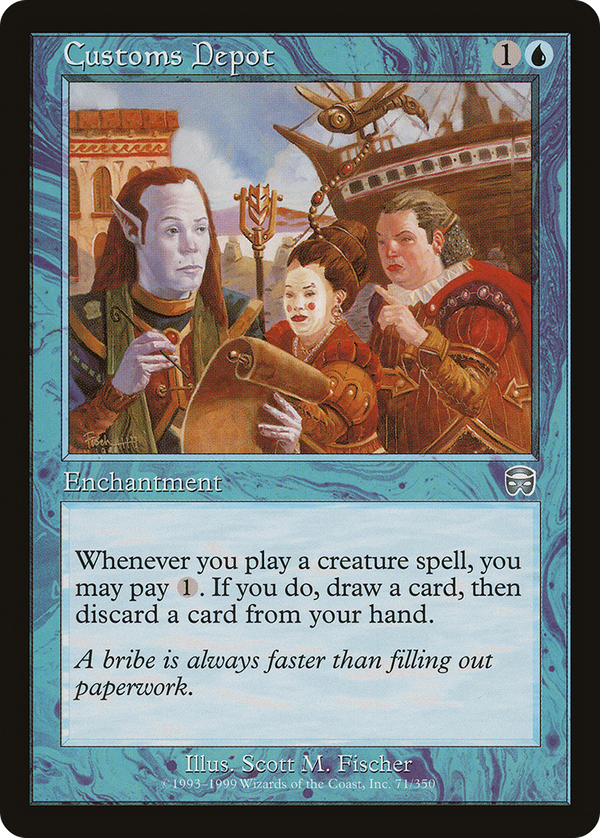
Rules text
. If you do, draw a card, then discard a card.