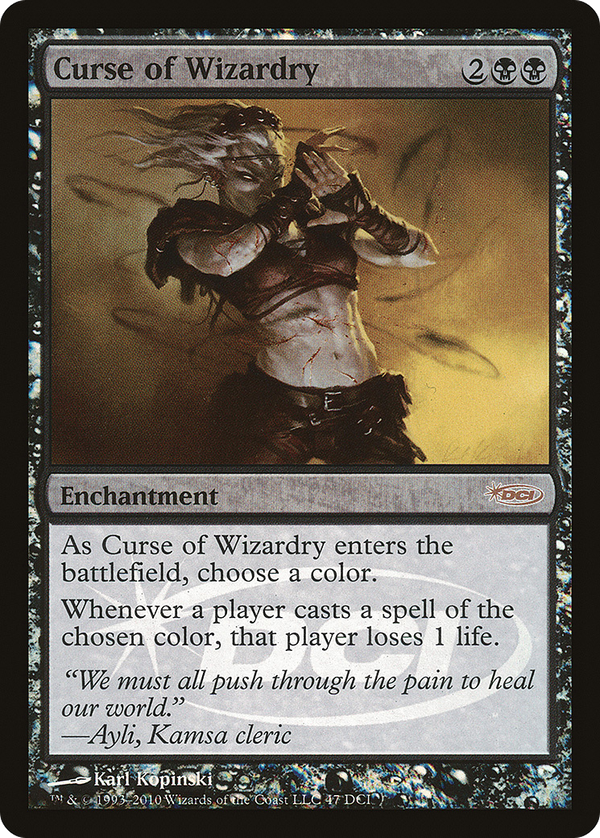
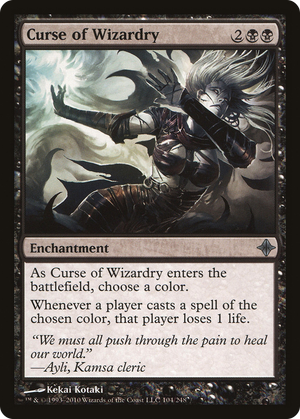
Curse of Wizardry


The design problem this never solves is the symmetry: the chosen color hits every player who casts it, including the one who deployed it. That makes the card a self-tax unless your own deck is built around a color it can name with impunity, and even then the life drain it produces is slow, incremental, and easy to ignore until late. A point per spell is not a clock; it is friction, and friction against a focused mono-color opponent who is already racing you tends to matter less than the four mana you spent making it. The era that produced this kind of effect was experimenting with hate cards aimed at the dominant archetypes of the day, the way Dystopia and various pithing-style answers tried to tax a strategy out of viability. Where those cards picked a card type or a mechanic, this one picks a color, which is both broader and blunter: it cannot distinguish between the opponent's win condition and a harmless cantrip, so it bleeds value across irrelevant spells while doing nothing to stop the relevant one. The choice-on-entry clause is the only real decision the card offers, and because four mana lands it in the mid-game, that choice is usually an informed read of what the opponent has already committed to, not a blind name on turn one.