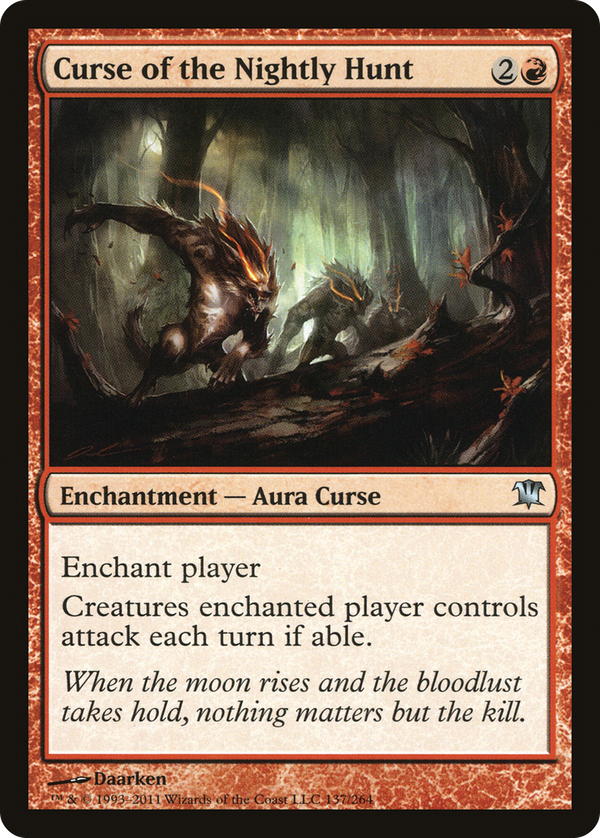
Curse of the Nightly Hunt


The Curse cycle's recurring design problem was always who the punishment lands on, and this one solves it by attacking the opponent's decision tree rather than their life total. Forcing every creature an enchanted player controls to attack each combat hijacks the most basic lever a defender has: the choice to hold back. That turns a creature-heavy board from a wall into a liability, peeling potential blockers off the board and shoving them into races the enchanted player would rather sit out. The effect is purely directional friction, with no clause that finishes the game on its own, so it leans on whatever else you have pointed in the same direction. It is a static, persistent compulsion stapled to one target, a forerunner of the forced-combat design that later got formalized into a keyword. The crucial difference is what it leaves out: this Aura only says creatures must attack, with no instruction about which player they swing at. Goad would add that second clause, steering the forced attacks away from the player who applied it; without it, in a one-on-one game the lever points straight back, since the only attacks it can compel are into your own defenses. The design clearly wants a third party, a crowded board, or a deck built to profit from combat that has to happen. That makes it a niche tool rather than removal, an enchantment that rewrites how an opponent is allowed to use their creatures instead of dealing with them directly.