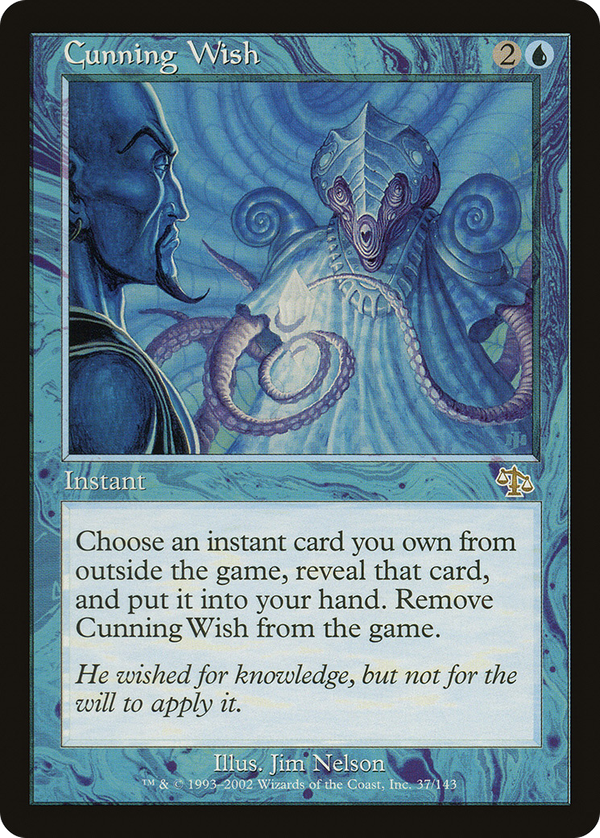
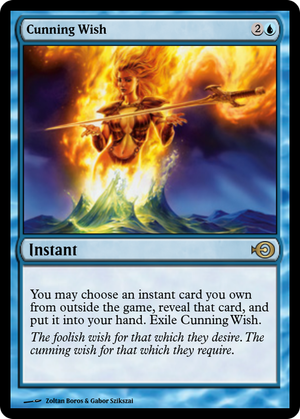
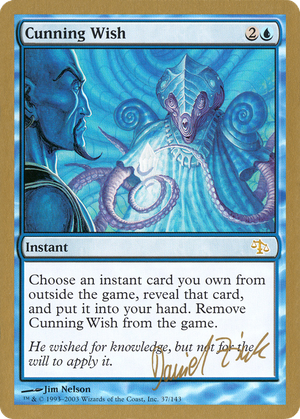
Cunning Wish


What separates the Wishes from a tutor is the destination: instead of digging through your own library, you reach outside the game to retrieve any instant you own, turning your reserve of unplayed cards into a singleton toolbox of answers you can summon during any window the stack allows. Burning Wish does the same for sorceries, Living Wish for creatures and lands, but the instant restriction is the one with the deepest implications, because it lets the maindeck stay lean while every situational answer (the extra counterspell, the niche piece of artifact removal, the surprise combo finisher) sits in reserve until the exact moment it becomes relevant. The exchange is card-neutral: one card spent, one card gained, a clean 1-for-1. What you actually pay is tempo, and not only the three mana up front. The fetched instant lands in your hand, not on the stack, so you still need the colored mana to cast it on a later beat: a slow line even when it is correct. The payoff is compression. A single copy effectively reads as "whatever instant in my reserve the situation demands," collapsing a dozen reactive slots into one elastic line that scales with the breadth of your toolbox rather than its depth. The design also became the cleanest case study in a long-running argument about whether reaching outside the game belongs in tournament play at all: an answer to nearly anything, gated only by the tempo it costs and the mana to follow through.