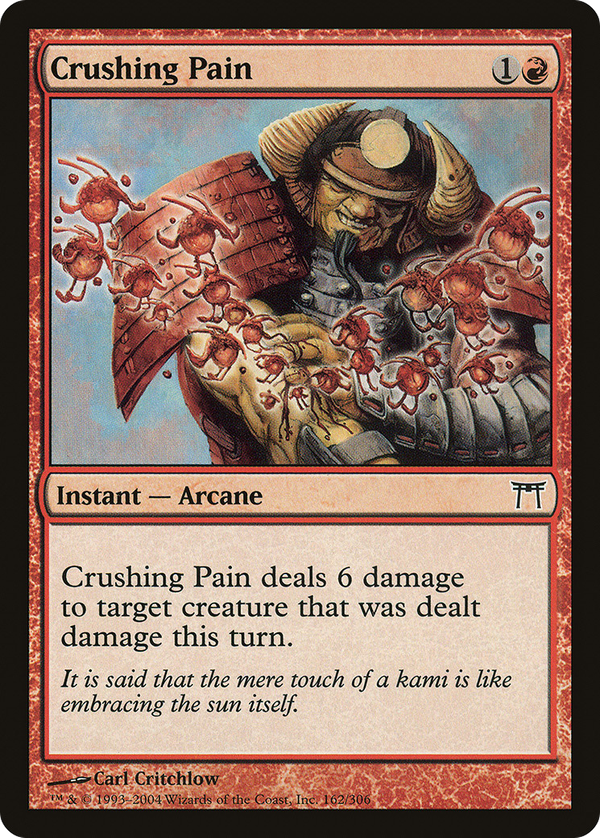
Crushing Pain


Six damage is gross overkill against almost anything you would point it at, and that excess is the whole conceit: the spell is priced for a board that has already committed to combat. The conditional clause does the costing. You cannot cast it on an untouched blocker or a fresh threat; something has to have taken damage this turn first, which usually means it traded blows in combat or ate a smaller burn spell. So the spell sits downstream of an attack already made, finishing a creature your team softened up rather than answering a problem out of nowhere. That places it firmly in the Spirit-and-Arcane aggressive shell it was built for, where splice and other instant-speed Arcane tricks chain off a single attack step, and the damage-dealt requirement reads less like a tax and more like a natural consequence of how those decks play. The six is generous precisely because the window is so narrow: by the time you can legally cast it, the creature you want gone is already half-dead, and the spell is paying for the privilege of not caring how big it got. It is a finisher for a board state, not a maindeck answer, and the gap between its raw damage output and its actual flexibility is the design speaking plainly about which half of the trade it expects you to be on.