Crude Rampart


Morph turns the usual problem with defensive walls inside out. A 4/5 with Defender is a perfectly serviceable blocker, but it broadcasts exactly what it is the second it resolves, and a board-stalling card that announces itself is trivial to play around. Hiding it under a morph buries that information: it sits as one anonymous 2/2 among other face-down threats, and the attacker is left guessing whether the thing in front of them is a fragile beater or a wall that will brick the whole assault. The flip cost ( ) is steep enough that you rarely unmorph it for raw value; the point is the bluff and the surprise blow-out, swinging into what reads as a 2/2 only to find a 4/5 waiting. That tension between Defender's permanent commitment to the back line and Morph's deliberate concealment is the entire design: a card built to defend, dressed so the opponent cannot plan around the defense. It is a humble common, but it captures cleanly what made the era's morph cycle worth studying, where even the most passive creatures got to play in a central guessing game.
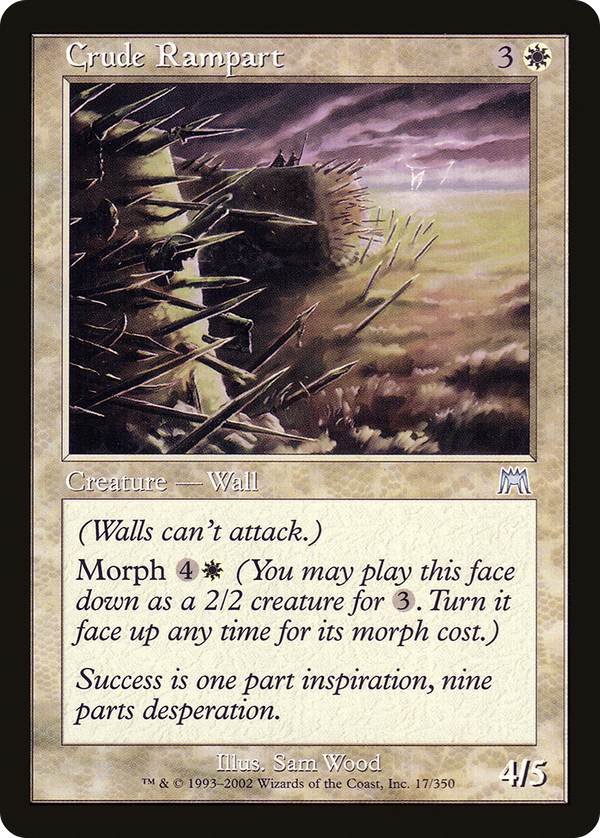
Rules text
(You may cast this card face down as a 2/2 creature for . Turn it face up any time for its morph cost.)