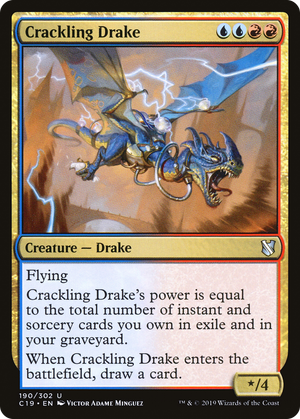
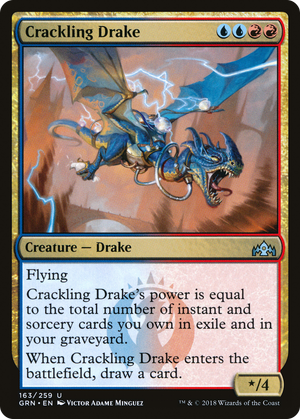
Crackling Drake


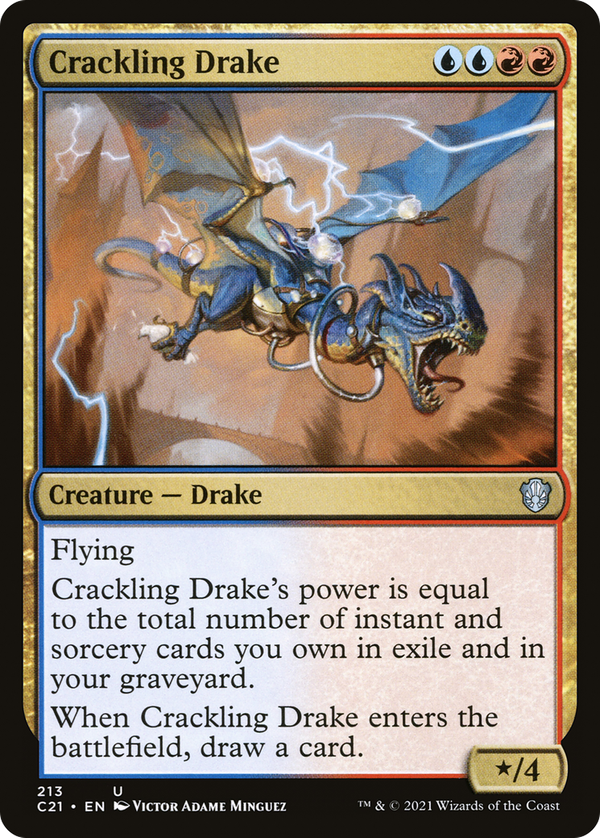
The body is the payoff for a deck that was already going to fill its graveyard and exile pile with burned cantrips and spent instants. Counting both zones is the structural detail that matters: it stays fed in shells built around delve, flashback, and cards that exile spells as a cost or an effect, so the same engine that fuels those mechanics also props up the Drake's power without asking for a dedicated payoff slot. A four-mana flier that replaces itself is a fair enough rate on its own, but the power is not a static buff with a comfortable floor; it counts cards, so a deck that has not yet spent any spells lands a 0/4 that traded four mana for a single draw. Spellslinger decks rarely cast it that dry, and that dependence is precisely the discipline the design leans on: the threat exists only to the degree the deck has already done its work. Because the power tracks a running count rather than a one-time triggered increment, it climbs every turn the deck spends resources, and it climbs off cards that have already resolved and exhausted their value elsewhere. The draw on entry makes it a chainable threat rather than a finisher you commit and pray over: it folds into the same cantrip cadence that grows it. This is the closer that converted Izzet's spent ammunition into a clock, an idea the instants-and-sorceries archetype had circled for years before the math got packaged this cleanly.