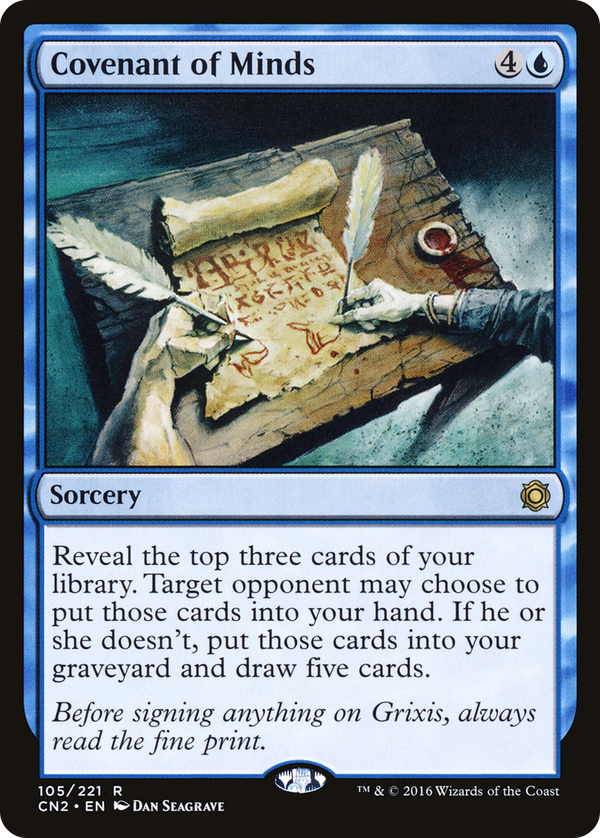
Covenant of Minds


A Fact or Fiction with the split handed to your opponent, except every branch they can take pays you. Reveal three off the top; the opponent decides whether you keep those exact cards or trade them for five fresh draws. The decision they make is a confession: bin the three and give you five only when those three are too good to let through, hand you the three only when five unknown cards off the top scare them more. So the choice tells you which half of your library the opponent fears, and you profit either way: a precise three-card pull or a deep refuel. That is the donor-of-the-choice design in clean form, an effect that looks symmetric and lands lopsided because the opponent's agency is the joke and the upside is always yours. The graveyard branch is the wrinkle worth building around: with recursion or graveyard payoffs, three binned cards plus five new ones is not a drawback at all but a stocked yard and a full grip in one cast. Stripped of that support it is raw card flow at sorcery speed, five mana for a slow value engine that wants a controlling deck with the breathing room to cash it in. The structure has aged better than the rate: an early-era experiment in handing the opponent a choice where both doors open onto the same room.