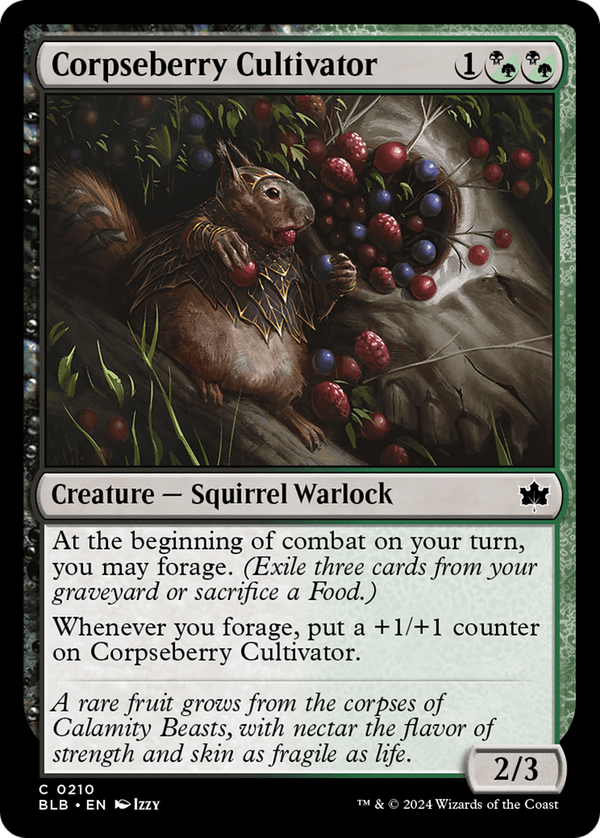
Corpseberry Cultivator


Forage exists to give the graveyard a second job: not fuel for reanimation or spellslinging, but a resource pile you burn for incremental board value. This is that mechanic's cleanest self-contained payoff. The combat-step trigger sets the tempo, offering to convert three exiled cards or a single Food into a +1/+1 counter right before you swing, so every growth step is timed to your attack. What makes the loop coherent is the hybrid cost: it slots into a color pair that already mills itself, sacrifices creatures, and manufactures Food, meaning the graveyard fills as a byproduct of playing the deck rather than something you have to engineer. The counter clause is written broadly (whenever you forage, not just from its own ability), so it rewards a shell stacked with other forage cards, and it doubles as a payoff for any Food you produce elsewhere. The tension is deliberate: a graveyard is a finite resource that other cards in these colors also want, so growing this out of control means starving your recursion. That is the honest limit on a three-drop-sized body that keeps reaching for more. It is the anchor a deck built around foraging wants at the top of its curve of small pieces, the creature that turns a mechanic's transactional cost into a clock.