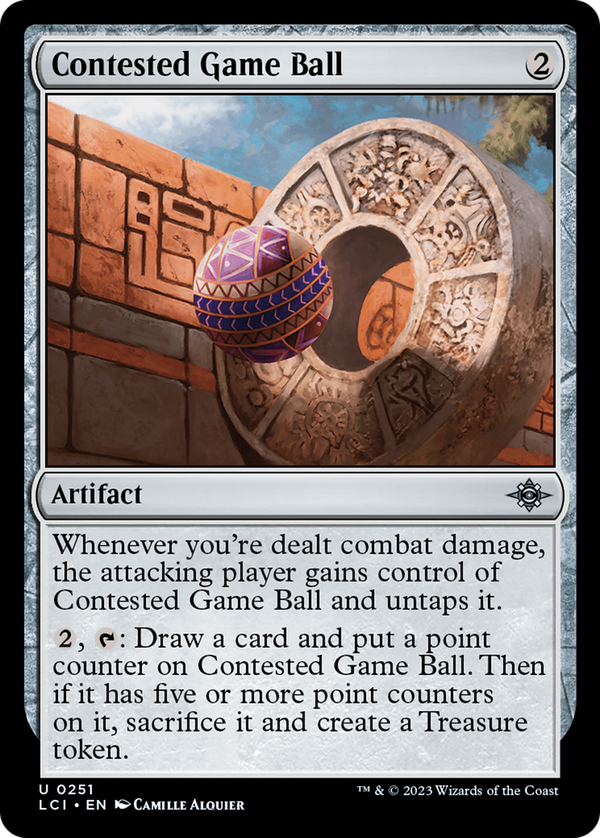
Contested Game Ball

Most card-draw engines answer to whoever owns them; this one changes hands. The activation is a straightforward pay-two-tap-for-a-card loop, but the counter it stacks is a fuse: hit five and the whole thing burns down into a Treasure, so the engine self-destructs before it runs away. The twist that gives the card its name is the control clause. Deal combat damage to the pilot and you seize the artifact, untapped, mid-loop, inheriting whatever counters are already on it and the shortened runway to its detonation. That turns a value piece into a contested object: whoever is winning the damage race is also winning the card-advantage race, and the fuse means the ball tends to explode in the hands of whoever grabbed it last. It rewards pressure rather than durdling, since sitting behind it and drawing does nothing to stop an attacker from walking over and taking it. The Treasure payoff on death softens the loss for whoever holds it at the end, a small consolation prize baked into the sacrifice. As a design it belongs to a small tradition of shared or stolen artifacts that make ownership a live question at the table, closer in spirit to a passed object than a static rock, and the combat trigger ties its value directly to who is landing hits.
Rules text
,  : Draw a card and put a point counter on this artifact. Then if it has five or more point counters on it, sacrifice it and create a Treasure token.