Conservatory
What a dual land does after it has served its early role is usually nothing: it taps for one of two colors and sits there for the rest of the game. This one folds a mana sink into the manabase itself, spending four mana and a tap to manufacture a Clue when the game stalls out and the colored mana stops mattering. The rate is deliberately steep (four plus a tap for a Clue you still have to pay two more to crack), which is the tax for stapling card advantage onto a land that produces two colors and costs nothing to play. The tempo cost is real, and it is front-loaded: the land enters tapped, so the flood insurance is bought on turn one, long before the ability ever pays out. That is the exchange the design commits to. Green and white is also the color pair least likely to be starved for gas, which makes the built-in draw read more like belt-and-suspenders than a lifeline, but raw power was never the point. The point is that a land which has run out of useful mana to tap for still has a button left to press: in a game where your hand is empty and your remaining lands are doing nothing, this one keeps generating something.
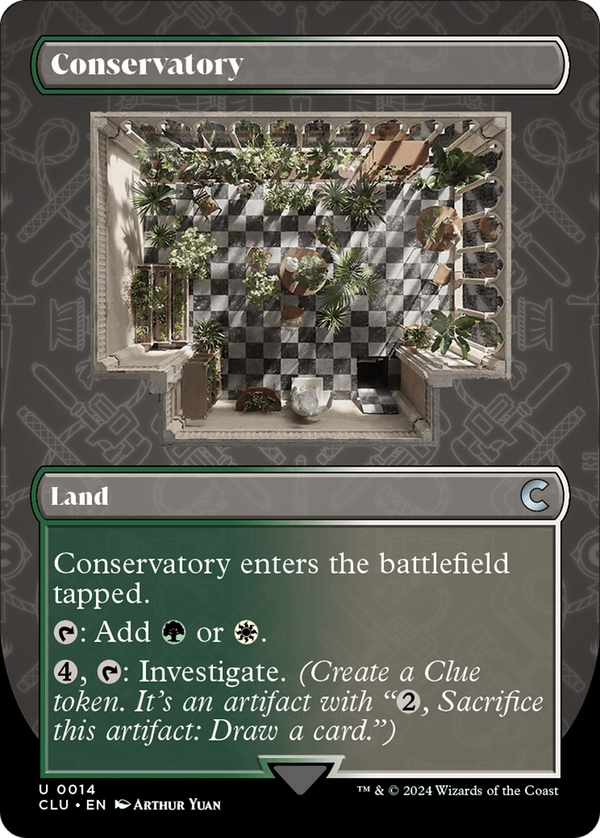
Rules text
 : Add
: Add  or
or  .
.
 , : Investigate. (Create a Clue token. It's an artifact with "
 , Sacrifice this token: Draw a card.")