Cone of Cold


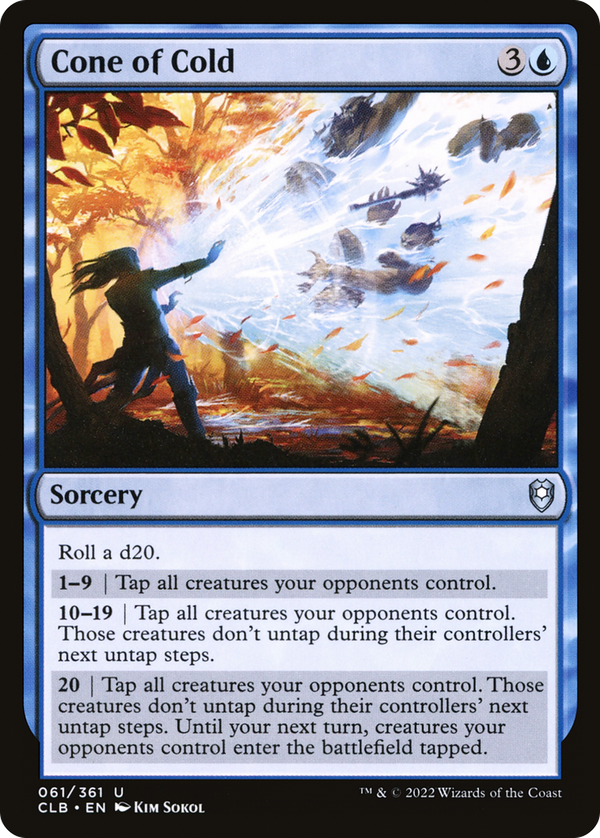
The name comes straight from tabletop D&D, and so does the d20 that governs how far the spell reaches. Underneath the roll it is a mass-tapper cast at sorcery speed, which reframes the whole effect: because you fire it on your own turn, tapping every opponent's creature is not a defensive Fog but an offensive falter, clearing blockers out of the way of your attack. The floor (a 1-9 roll) does exactly that and nothing more, since those creatures simply untap on the way back to their controllers; it is a swing-enabler, not a stall. The die's value is in the ceiling. A 10-19 result adds a stuck untap step, so the board that just got run over cannot rebuild a defense in time for your next assault, and the tap-down doubles as a soft Time Walk against a permission-light opponent. A natural 20 stretches the suppression into an ongoing tax: opponents' creatures enter tapped until your next turn, which strips flash blockers of their blocking window and leaves freshly cast threats unable to gum up the ground during your swing-back. That range is the design's real content. A single card scales from "clear the path once" to "lock the ground for two full turns" without three separate printings to cover the spread, and the randomness is graduated upside rather than a whiff you have to survive, which is the cleaner way to build a die roll into a tempo-oriented blue spell.