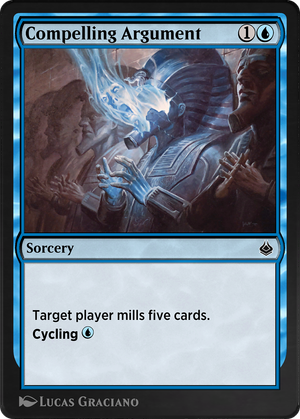
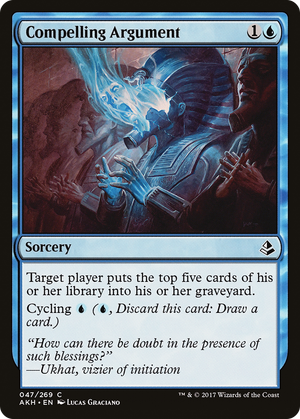
Compelling Argument


Mill as a primary win condition has always lived or died on consistency rather than raw power, and its structural weakness has always been the same: the mill spell that does nothing in the matchups where grinding out a library can't close the game, a dead card with no exit ramp. Cycling is the exit ramp. Five cards to the graveyard advances a self-mill or opposing-mill plan when that plan is live; when it isn't, a single blue trades the spell away for a fresh draw off the top. That trade is what lets a flat, unglamorous mill rate exist at all: the floor is never zero, because the floor is a spell that replaces itself. It's the difference between a build-around payoff that clogs your hand against the wrong opponent and a low-variance piece that always does one thing or the other. Stapling draw-replacement onto a mill effect is a quiet but pointed fix to a fragile archetype's core problem: it lets a deck run more milling spells without diluting its draws, because the worst case of each one is still card parity, not a wasted card. Nothing here is flashy. The design lesson it carries, about smoothing out a strategy that fails on variance rather than ceiling, is the part worth keeping.
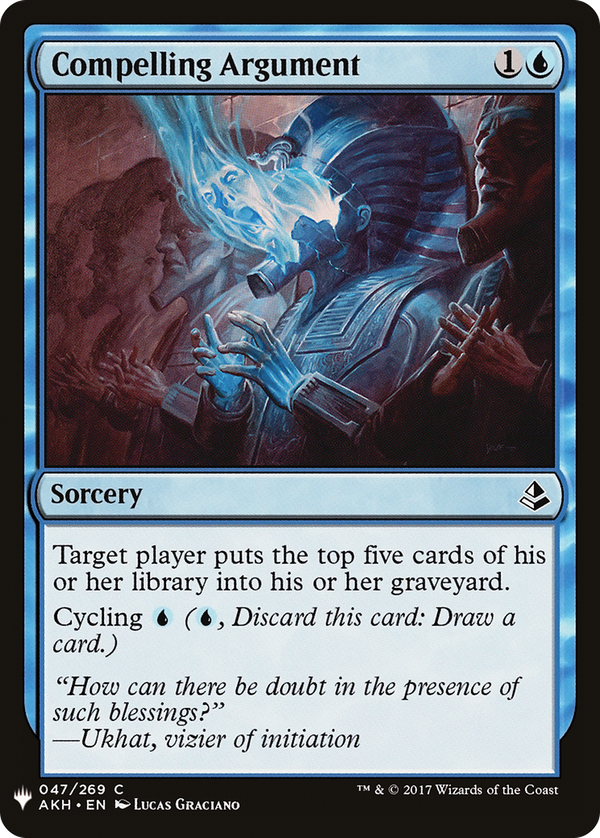
Rules text
(, Discard this card: Draw a card.)