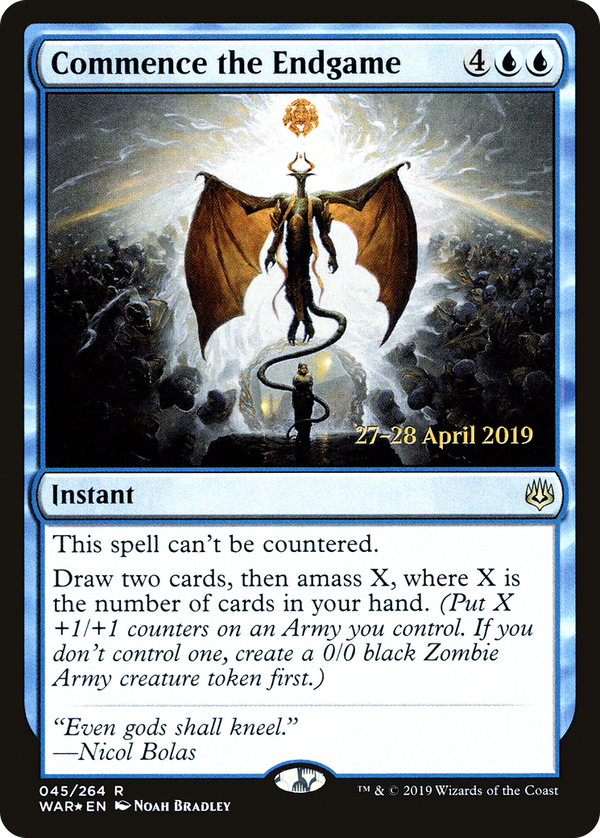
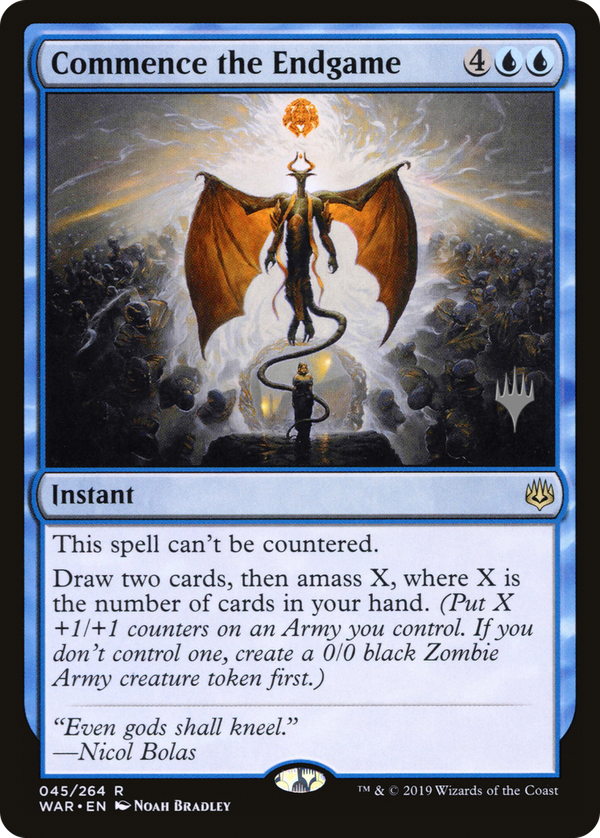
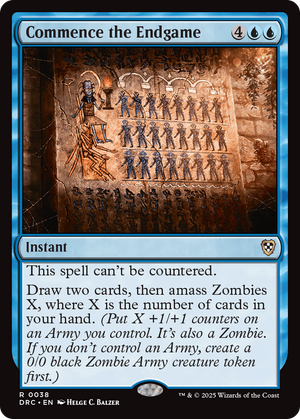
Commence the Endgame


The clever trick here is a feedback loop that most card-advantage spells never dare touch: drawing first, then sizing the payoff off the fuller hand. Refilling to two extra cards is standard blue business, but the Army it produces scales to whatever your grip holds at that instant, which means the same spell that keeps you alive on cards also builds a body large enough to matter. Cast it with a stocked hand and the Zombie Army balloons; cast it while topdecking and you still bank the two cards. That flexibility is why the instant speed matters as much as the amass: this is a draw step you can hold up as a bluff and a flash threat you can drop at end of turn, all in one window. The can't-be-countered clause slots naturally into a control mirror, where the whole point is to resolve your card-advantage engine through a wall of interaction. Amass was a keyword built to let noncreature cards contribute to a single growing Army across a deck, and this is the payoff piece that best exploits it: you don't need other amass cards to make it worth casting, because it seeds the token itself if you have no Army yet. The design tension it resolves is the old problem of the expensive instant that either draws cards or affects the board but rarely both meaningfully; here the two halves feed each other rather than competing for the slot.