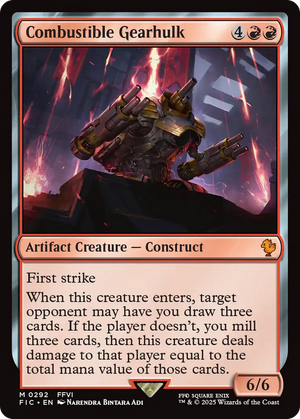
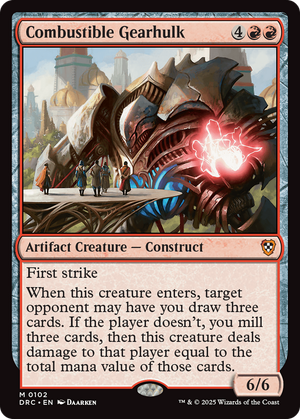
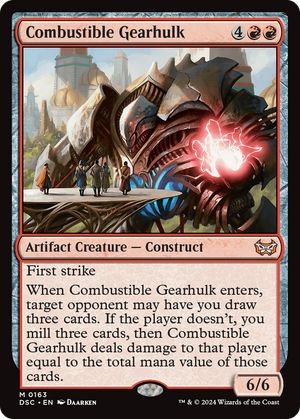
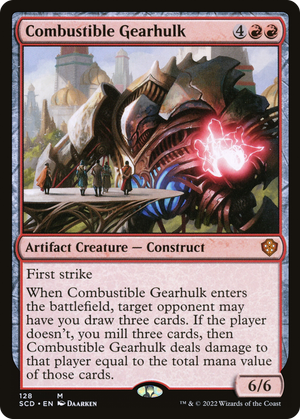
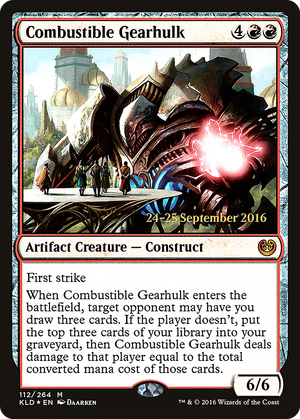
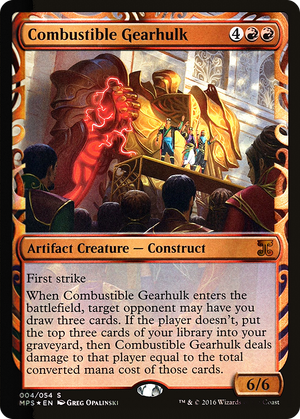
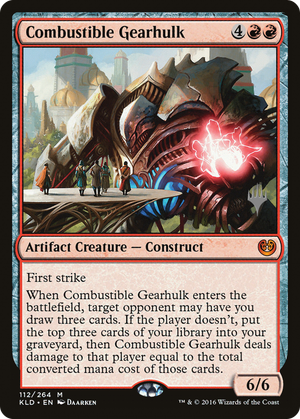
Combustible Gearhulk


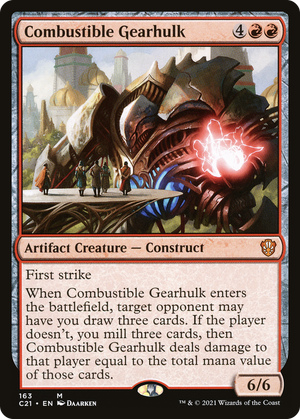
The whole thing turns on handing your opponent a choice you've rigged so neither answer is comfortable. Three cards drawn is a hard cost to pay; burn equal to the milled cards' total mana value is a payoff that scales with your own curve, and against a deck stuffed with six- and seven-drops it can read like a second Fireball stapled to a 6/6. That asymmetry is the engine: the more top-heavy your list, the more the damage branch threatens, so the opponent has a real reason to swallow it rather than refill your hand. Tighten the curve toward cantrips and one-drops and the math inverts on you: the damage becomes negligible, an opponent will happily eat it to deny you three cards, and you have effectively given yourself a hard mode. The card wants both branches to sting, which is a narrow window to build into. First strike on a six-power frame is the floor that keeps the body relevant regardless of which mode resolves: even when an opponent simply hands you three cards and moves on, you've spent six mana on a creature that dominates the ground. The mill clause is delivery mechanism more than graveyard strategy, the dice-roll that sets the damage number. Of the construct cycle built on this enter-the-battlefield punisher template, this is the one whose effect bends hardest toward the deck around it, which is also why it never quite settled into a single home.
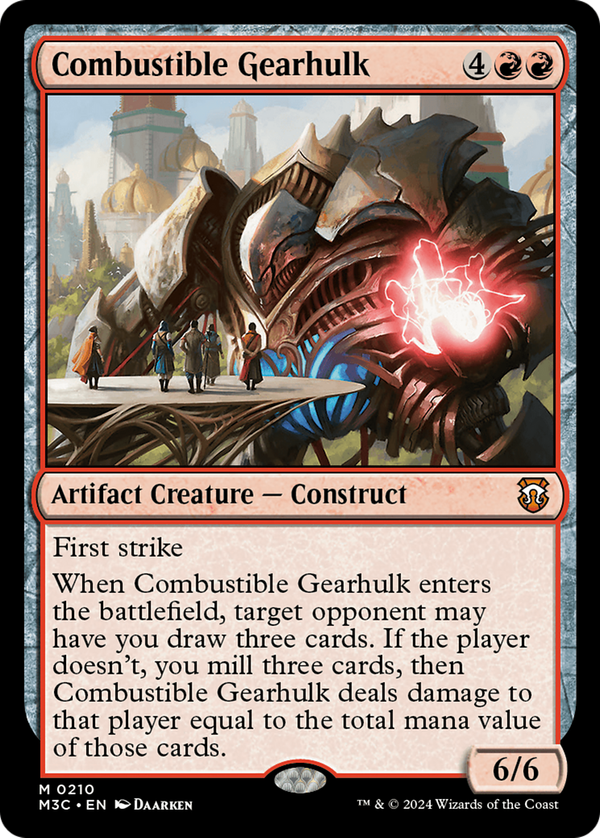
Rules text
Format Status
More formatsFewer formats
Other printings
- Final Fantasy Commander#292
- Aetherdrift Commander#102
- Duskmourn: House of Horror Commander#163
- Starter Commander Decks#128
- Commander 2021#163
- The List#KLD-112
- Kaladesh Remastered#120
- Kaladesh#112