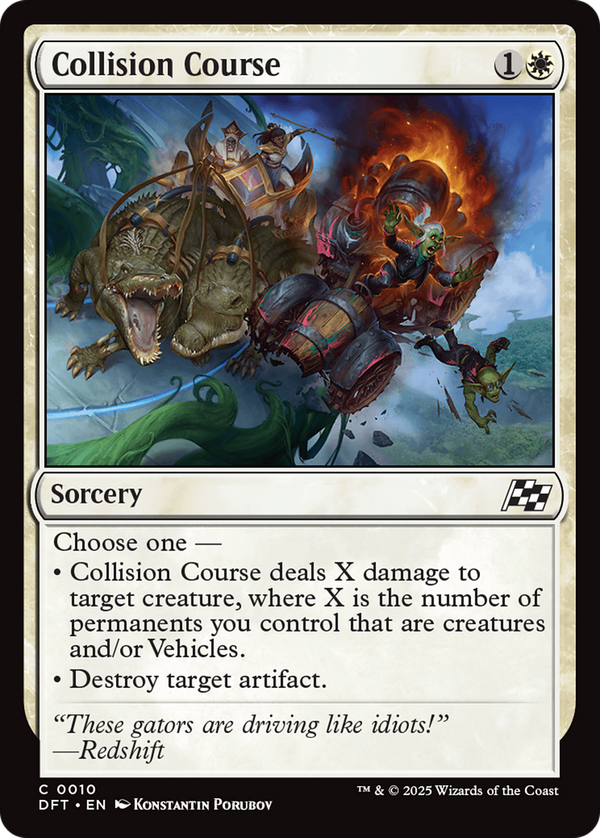
Collision Course


White does not get to point a burn spell at a creature very often, and the wrinkle here is that the wattage comes from your own board rather than red's usual rate. The first mode counts your creatures and Vehicles and turns that number into damage, so the removal scales precisely with the kind of go-wide deck white already wants to build: play out a few bodies and this reads like a one-sided combat step compressed into a sorcery. On an empty board it does nothing, so the card asks you to earn its ceiling before you cast it, and it rewards the same commitment that leaves you exposed. Vehicles pulling their weight in the count is what signals the shell this was drawn up beside: a permanent type that sits on the battlefield without being a creature until crewed still feeds the damage total, quietly boosting decks leaning on that frame. The second mode, plain artifact destruction, is the pressure valve. When the board math is not there, or when the thing you actually need dead is a mana rock or an equipment, the card folds into a role white has always filled cleanly. Modal removal that switches between killing their threat and answering their artifact keeps the card from rotting in hand against the wrong opponent, which is the whole argument for spending a slot on a sorcery whose first mode is contingent on your own development.