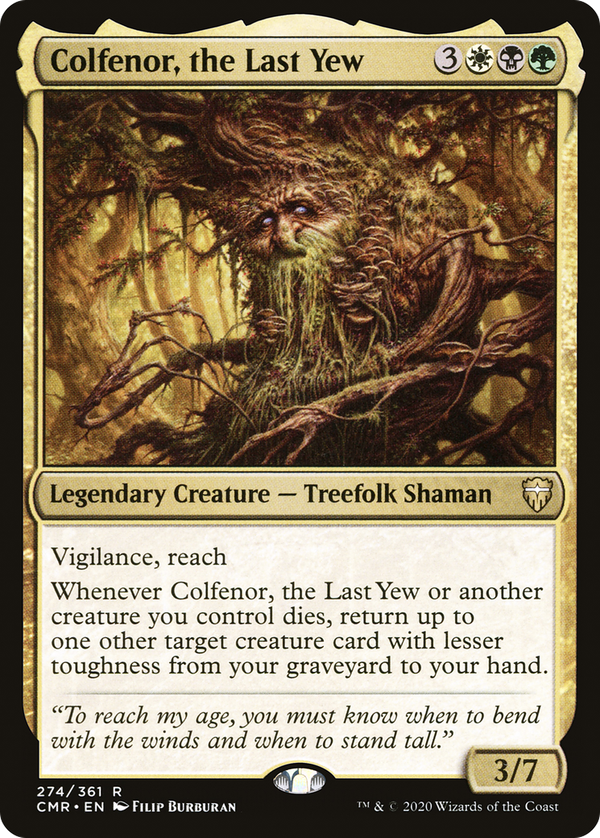
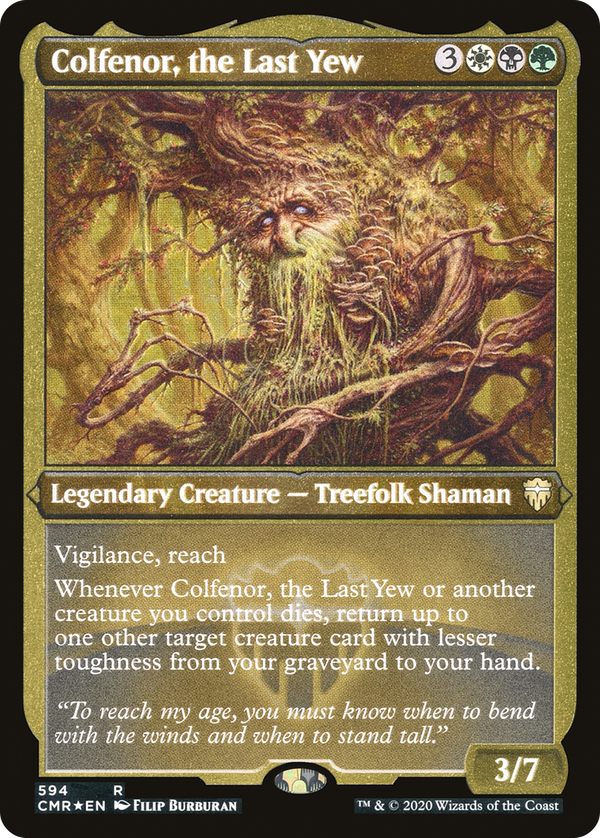
Colfenor, the Last Yew




The recursion clause reads simple until you notice the word doing the sorting: whatever you return has to have lesser toughness than the creature that just died. That single constraint rewires the whole engine. This does not loop a value creature back to itself the way a Reveillark or Karmic Guide chain does; every death sets a ceiling, and you reclaim something beneath it. Sacrifice your biggest body and the yard opens wide; sacrifice a one-drop and you can only fish back the very smallest fodder. The engine grinds sideways rather than exploding, because the fattest threat can never buy itself back. The 3/7 frame is the tell for how the designers wanted it played: a defensive wall with reach and vigilance that survives combat, holds the ground, and converts your board's attrition into cards instead of tempo. It wants a graveyard populated with a spread of toughness values and it wants creatures dying every turn, so a sacrifice-and-death-trigger shell is the natural home, feeding fodder in one direction and pulling replacement bodies in the other. The Abzan color triple matters here too: white, black, and green is the wedge that has always traded small creatures for long-game inevitability, and this Treefolk Shaman is the recursion axle that trade wheels around. The toughness gate is less a flavor tax than the throttle that keeps the loop honest, rationing what comes back so the value stays incremental.