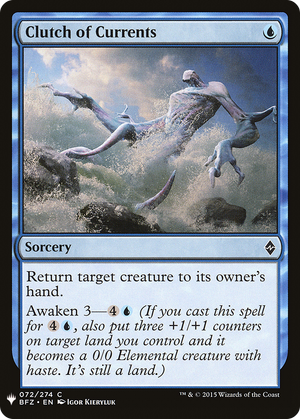
Clutch of Currents

The cleanest illustration of what awaken was built to solve: the dead late-game tempo spell. A one-mana sorcery-speed bounce is the kind of card that floods the hand and stops mattering once both players have a board, and the whole awaken cycle exists to give those early-game effects a second gear that scales into the turns where you'd otherwise be discarding them. Cast it for and it's a sorcery-speed Boomerang restricted to creatures; cast it for  and that same bounce arrives stapled to a 3/3 hasty land that swings the turn it lands. The design discipline is in the counters going on a land rather than a fresh body: you commit no extra card to the board, so the awaken side gives you a beater without spending a second card to deploy it, and the land keeps tapping for mana when it isn't attacking. The cost of that efficiency is real, though, since an awakened land is now a creature: a board wipe doesn't just kill it, it sets you back a land, which is a steeper loss than trading away a normal body. The tension awaken navigates is that a flexible spell is usually a weak one, a card good at two jobs tending to be mediocre at both. Here the floor and ceiling share a single line of text and a single target structure (creature for the bounce, your land for the counters), so the card reads as one effect with a switch rather than two compromises bolted together. It's the modal-spell instinct: pay less for the now, pay more for the later, and never hold a blank.
Rules text
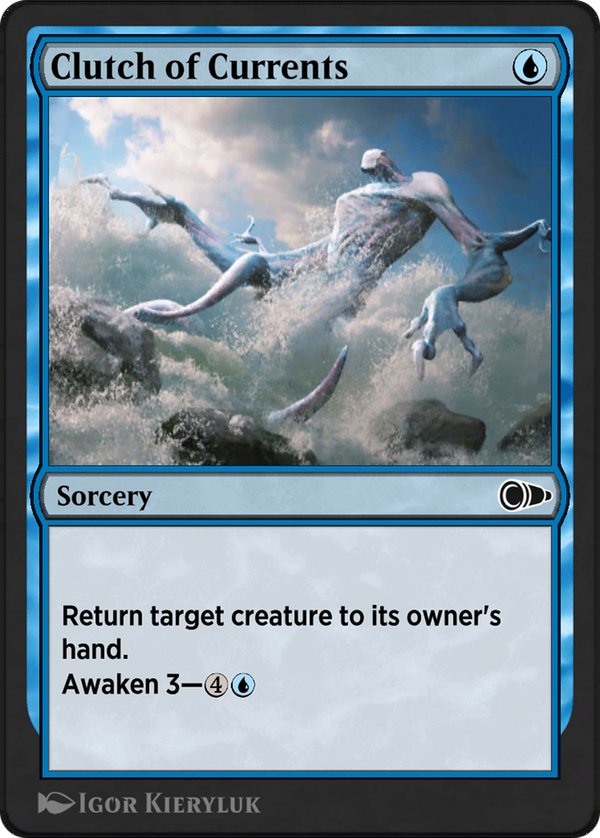
(If you cast this spell for , also put three +1/+1 counters on target land you control and it becomes a 0/0 Elemental creature with haste. It's still a land.)