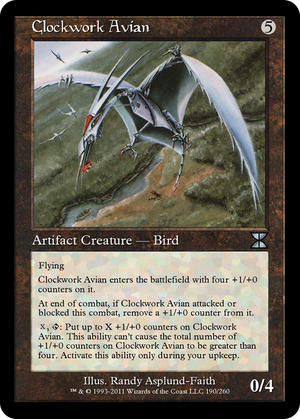
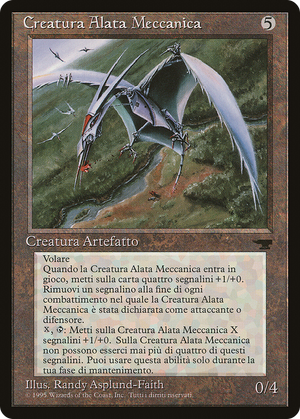
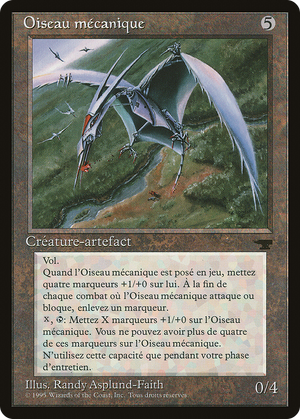
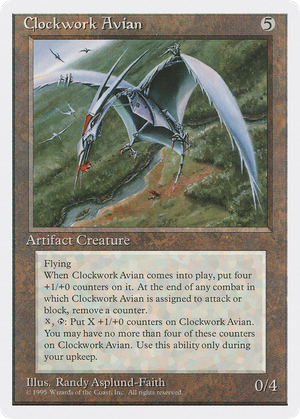
Clockwork Avian

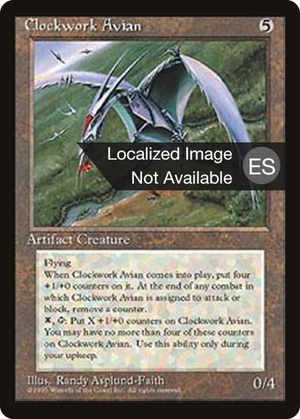
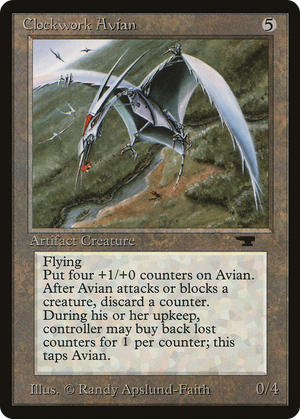
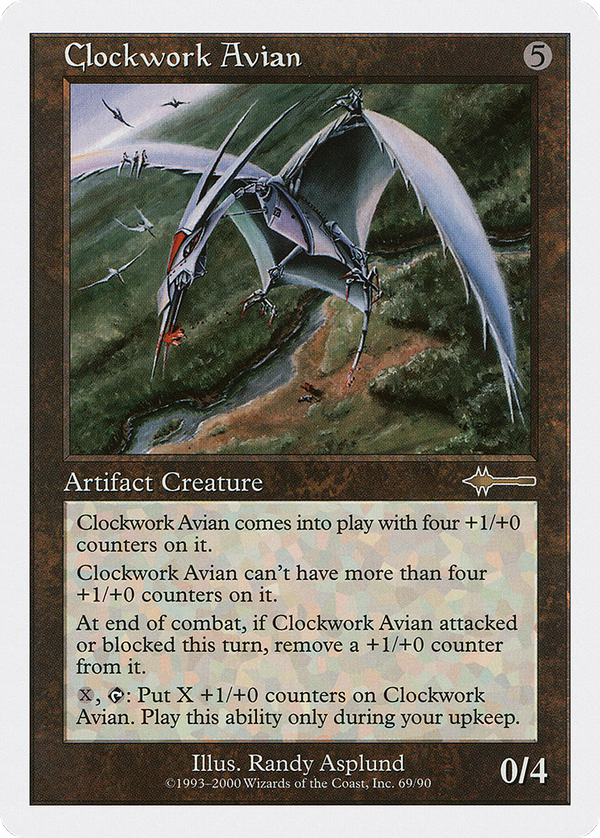
An early experiment in self-regulating creatures, and one of the clearest design statements from the artifact set that built Magic's first mechanical vocabulary. The clockwork cycle answered a question that vanilla creatures could not: how do you print a flier that swings hard but carries a built-in cost for doing so? The answer was a wind-up counter pool that drains with every swing or block, capped at four and refillable only during your own upkeep, before you ever reach a main phase. The result is a flier that starts at four power and loses one with each combat, then asks for mana and a full turn cycle to wind back up. That tempo tax is the entire point. Flying at four power was a serious threat in 1994, and the counter mechanism is what kept the rate honest; you paid the upfront five, then paid again, on a tightly fenced timing window, every time you wanted to keep attacking at full strength. The +1/+0 counters (rather than +1/+1) are also load-bearing: the toughness stays fixed at four, so the bird does not get easier to kill as it tires, only less threatening. It is a piece of design from before keyword counters or fading or vanishing existed, doing the same structural work those mechanics would later formalize. The clockwork frame never quite caught on as an evergreen, but its logic (a creature that costs resources to maintain at peak) shows up in every wind-down mechanic since.
Rules text
 ,
,  : Put up to X +1/+0 counters on this creature. This ability can't cause the total number of +1/+0 counters on this creature to be greater than four. Activate only during your upkeep.