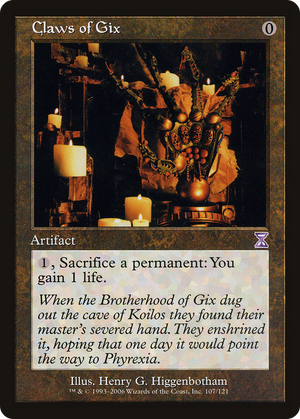
Claws of Gix

Free to cast, and that zero is the entire design. The body does nothing for your board; it exists to convert permanents into a repeatable sacrifice engine, one mana at a time. The lifegain is almost incidental, a fig leaf on what is really a permanent-eating machine: a way to sacrifice creatures, tokens, lands, or itself at instant speed, as often as you can pay the activation cost. That makes it a building block rather than a payoff. It does not care what you sacrifice or why; it cares only that you have things to throw away and a reason to want them gone. Decks that generate disposable permanents, or that win on the death triggers and graveyard fuel those sacrifices produce, get an outlet that drops onto the battlefield for nothing and then scales with available mana. The danger in a card like this has always been the gap between floor and ceiling: a do-nothing artifact that asks zero to deploy, sitting on top of an unconditional, recurring sacrifice loop, which is exactly the shape combo decks hunt for. The activation cost does little to restrain it; one mana per sacrifice is a soft tax, not a hard limit, and a board full of fodder turns that tax into a formality. It is an early template for the kind of cheap, open-ended sacrifice outlet that taught Wizards to be careful about how much they give away for free.
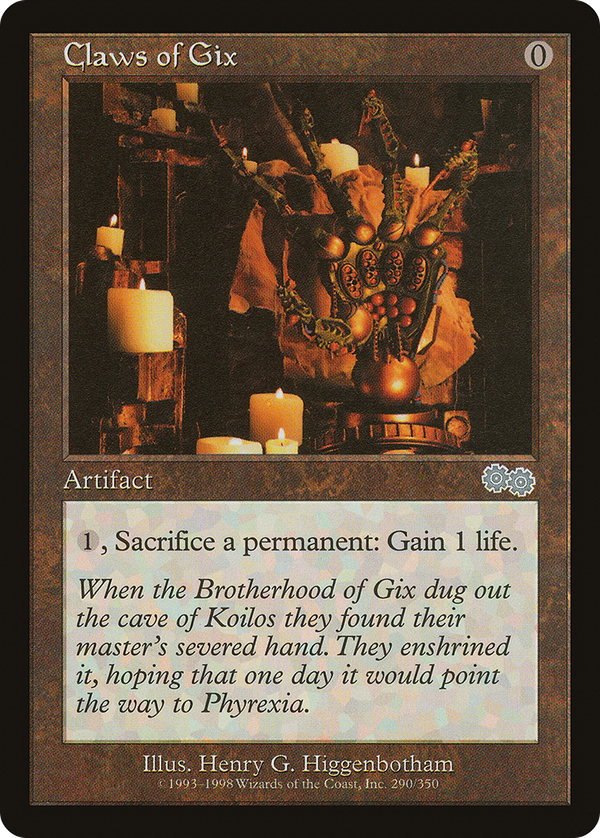
Rules text
 , Sacrifice a permanent: You gain 1 life.