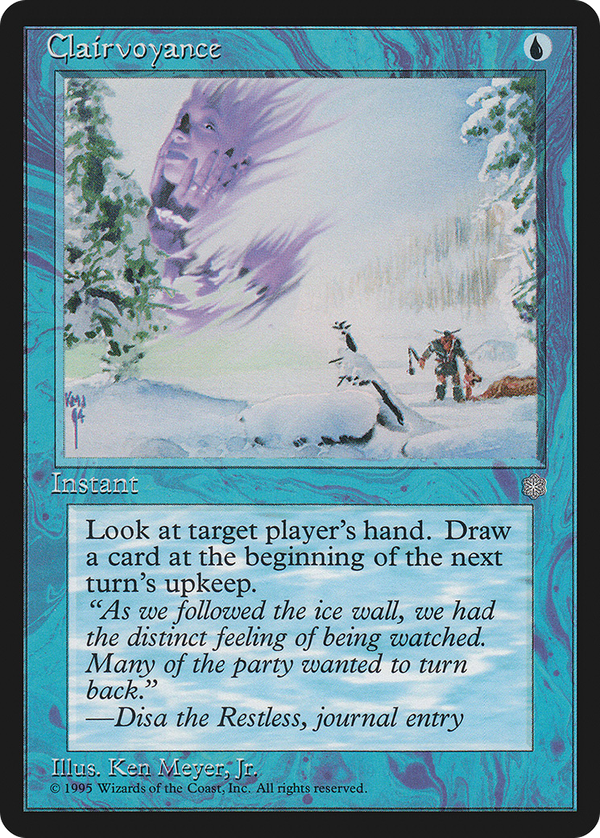
Clairvoyance

A perfect artifact of mid-90s design philosophy, when a single blue mana could buy you information but never quite for free. The card delivers two effects in one slot: it shows you a target player's hand now, and instead of refunding a card on resolution, it parks the draw on the next upkeep. That deferral is the entire design lever, though its bite depends on timing. Hold it for your own turn and the replacement waits until the next turn's upkeep; fire it during an opponent's end step and the card arrives almost immediately on your following upkeep. Peek, the functional cousin that simply draws when it resolves, is the cleaner card precisely because it skips this hoop. The structure tells you everything about how the era priced card advantage. The draw is what keeps the spell from being pure card disadvantage; without it, you would be trading a card in hand for a glance at someone else's. So the design pays you back, but on a delay you can manipulate by choosing the moment of casting, taxing the timing rather than the rate, because looking at a hand was considered strong enough that an immediate replacement would have been an overpay. The intelligence is the real product; the upkeep draw is the rebate that keeps the cost from stacking against you. It reads as a curiosity now, but it captures a moment when knowing an opponent's plan was treated as a resource worth charging for, the payment structured so you never quite got it for nothing.