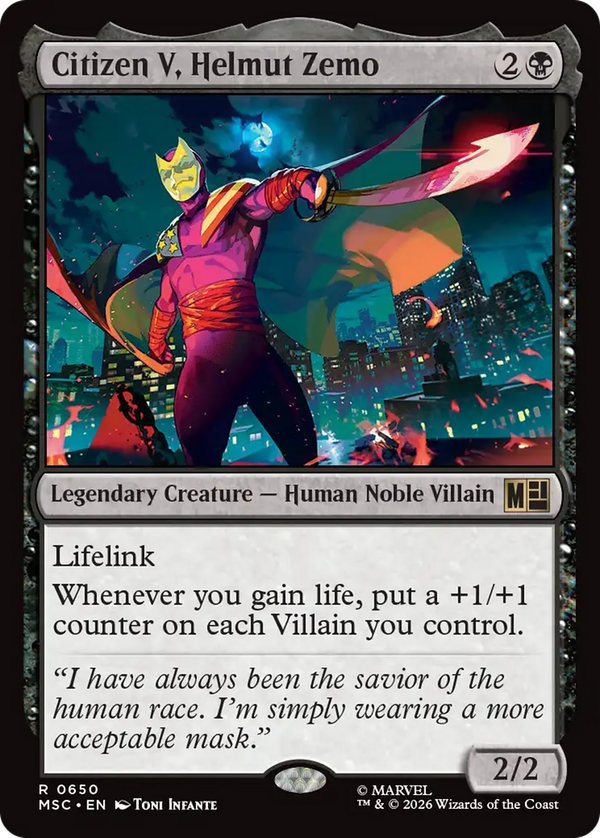
Citizen V, Helmut Zemo


Lifegain payoffs in black and white almost always route value back to a single point: one creature that grows, one life-total threshold that flips a switch. This one distributes the reward across a creature type instead, and the distinction that matters is that it counts events, not amounts. A single point of life and a ten-point one-shot heal do the same structural work: each fires the trigger once, planting one counter on every Villain you control. That inverts how you'd normally value your lifegain sources. A Soul Warden effect that drips a life per turn is worth more here than one big splashy heal, because frequency, not magnitude, is what compounds the board. The 2/2 body pays for its own trigger every combat via lifelink, but a single attacker cannot feed the engine on its own, so the deckbuilding pull is toward density of small, repeated gains: lifelink bodies, incidental drain, aristocrat loops. As a tribal capstone the ceiling is set by the type line rather than any one interaction; the more bodies carry the Villain tag, the wider each life-gain event lands. What it represents is a modern shape of counter payoff, neither a static anthem nor a one-time pump, but a feedback loop whose output is permanent, board-wide stat growth that ratchets one event at a time.