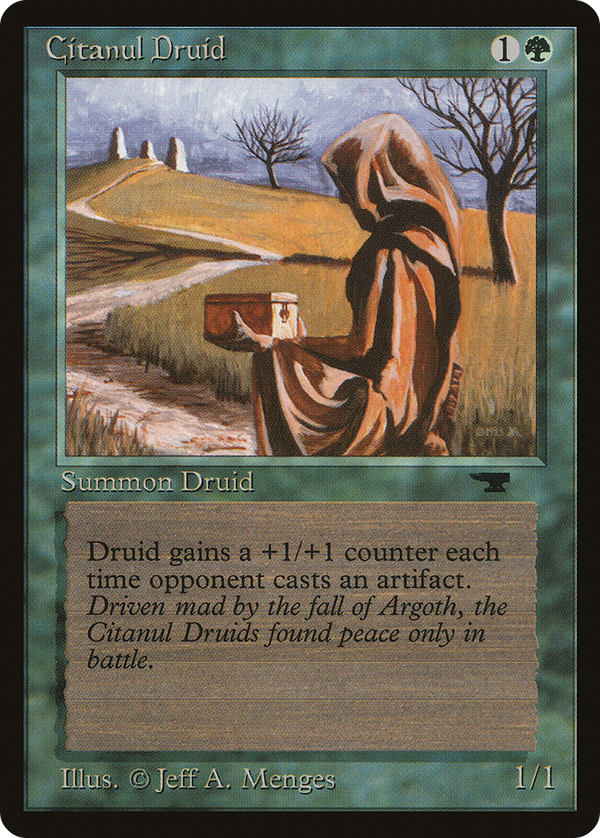
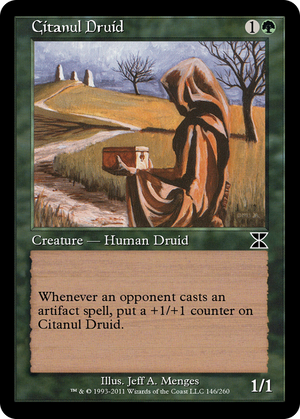
Citanul Druid


A 1/1 that grows only when someone else builds your power: the entire rate is outsourced to the opponent's deck choice. Against a board that never casts an artifact, you have spent two mana on a creature that stays exactly where it started; against the Urza-era artifact decks of the time, you have a body that scales linearly with the opponent's combo turn, swelling on the stack as each spell goes up. That conditional-payoff structure (cheap floor, ceiling determined elsewhere) was the period's preferred way to price hate, and green's contribution to the question was characteristically literal: not a tax, not a lock, just a creature that gets bigger. The trigger watches the cast rather than the resolution, so even a countered artifact still feeds it, and nothing caps the counters. Later white and green answers like Gaddock Teeg and Stony Silence took the same conditional-hoser idea in a punitive direction, restricting what the opponent can do; this one only profits from what they choose to do anyway. More a historical curiosity than a card with a competitive record, but a clean window into how early design built sideboard-shaped creatures into the main deck: floor low enough to run, ceiling high enough to matter, with the dial held entirely by the other player.