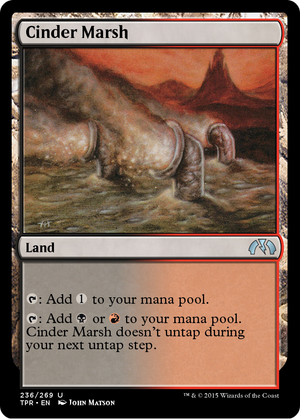
Cinder Marsh
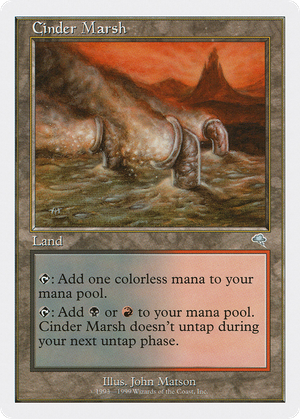
The colored mana here comes with a bill, and the bill is paid in tempo. Tapping for colorless costs nothing, but pulling black or red out of this land leaves it sitting dark for a full rotation, locked down across the following turn. That tradeoff is what holds the card back from being a strictly-better basic: you can reach for an off-color splash in a pinch, but you cannot lean on this for the turn-after-turn curve a true dual gives you. The design reads as a deliberately lossy converter rather than fixing you can build a whole manabase around. Tempest shipped a cycle of these slow duals across all ten color pairs, and they belong to a broad family of early fixing that charged for color access in something other than life or mana value: the original dual lands gave it away free, painlands billed life, this one bills a turn of availability. The lineage matters because it captures how cautious land design was before fetchlands and shocklands collapsed the cost of two-color manabases. Measured against modern fixing the tax looks brutal, but it is a clean snapshot of an era when reliable colored mana was supposed to hurt.
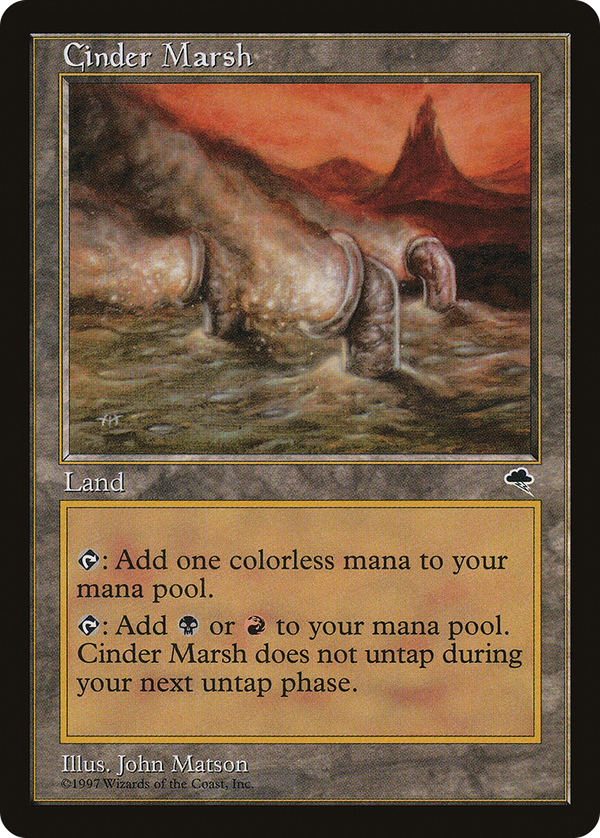
Rules text
 : Add
: Add  .
: Add
.
: Add  or
or  . This land doesn't untap during your next untap step.