Chorus of the Conclave



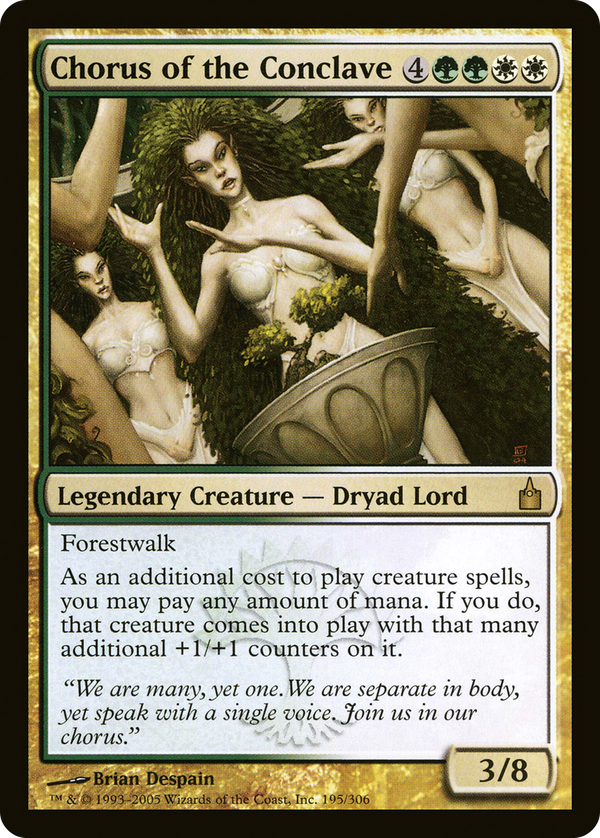
A 3/8 Dryad that costs eight mana is already telling you which half of the game it expects to be playing: not the early development race it sits out entirely, but the long midgame where you have mana to burn and a hand to convert. The open-ended pump clause has no ceiling and no timing wrinkle beyond the creature spell it taxes, so the only real constraint is your own mana: every point poured into a single creature is a point you did not spend casting another. Those counters land on the spell you are casting and nowhere else, which sharpens the tension rather than easing it. You are not distributing value across a board; you are deciding whether one swollen threat is worth more than several ordinary ones. This is the going-tall counterpart to the guild's wide instincts, the inverse of the cost-reduction tempo plan that later earned its own keyword. The body underlines the awkwardness of the shape: a high-toughness wall built to grind, attached to a forestwalk clause that wants to attack into green-heavy boards. A defensive frame that asks you to win by overcommitting to offense is an uncomfortable design, and the card has always read more as a literal rendering of the Conclave's overgrowth flavor than as an engine anyone bent a format around.