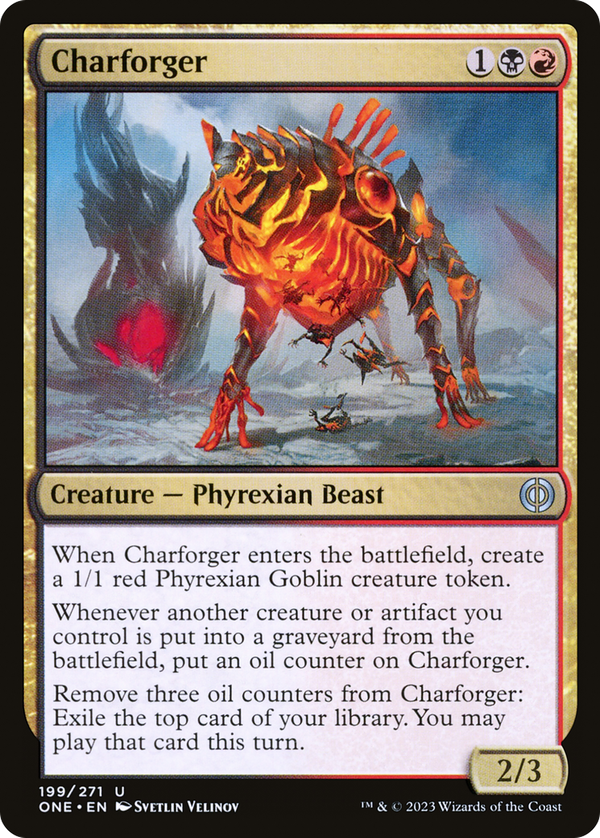
Charforger



Oil counters are usually a passive resource: they accumulate on a permanent that spends them all at once, or they tick down toward a single payoff. Here the resource loop is fed by attrition, which is where the design gets pointed. The token it makes on arrival is not a bonus body so much as the first piece of fuel: a 1/1 you are meant to trade, sacrifice, or throw under a blocker, because every other creature or artifact you control that dies puts a counter on this. Three counters buy a card off the top of your library, so the engine converts board attrition into raw card advantage at a fixed exchange rate. That reframes what looks like a fragile 2/3 into an aristocrats payoff: it wants you to be losing permanents, and it rewards a deck already built to feed a graveyard. The friction is the arithmetic. Three deaths per activation is a real tax, and the impulse-draw is one card at a time, played that turn or lost, so it does not bank value the way a repeatable draw engine does. The counters do not tick down on their own, which means the ceiling scales with how sacrifice-heavy the shell around it gets. On its own the body is unremarkable; wired into a machine that turns bodies into fuel, it is the meter that reads a grindy board state and pays it back in cards.