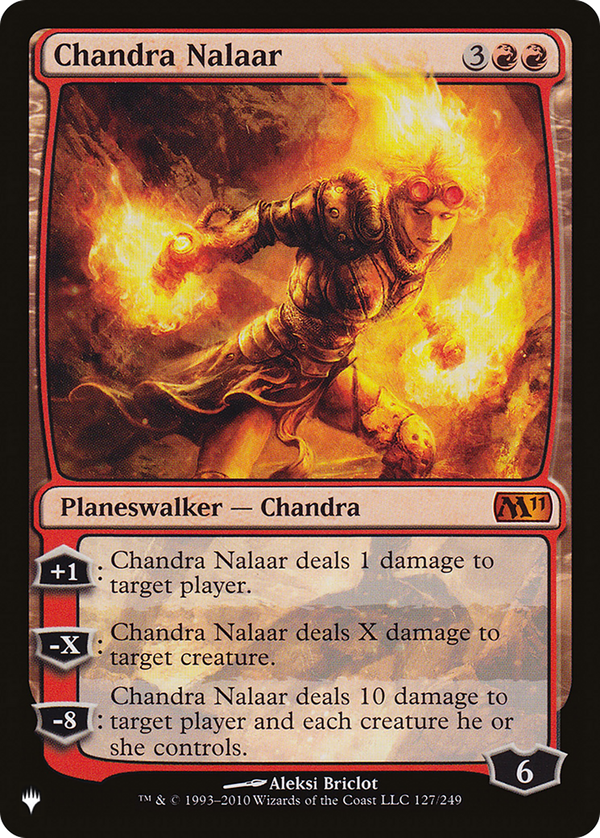
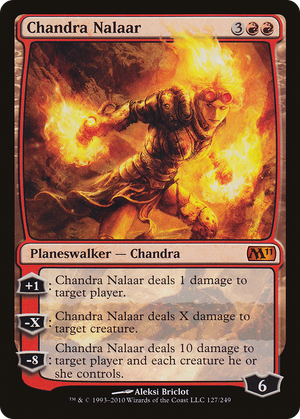
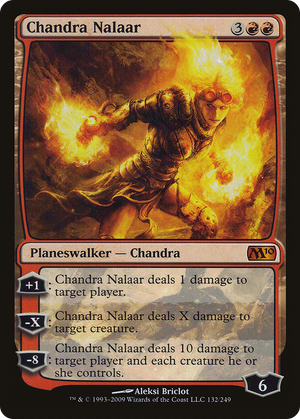
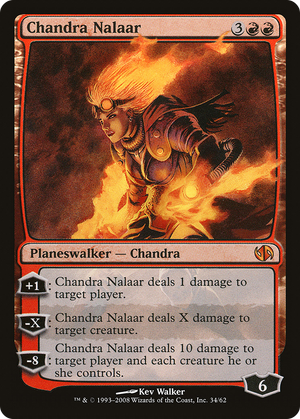
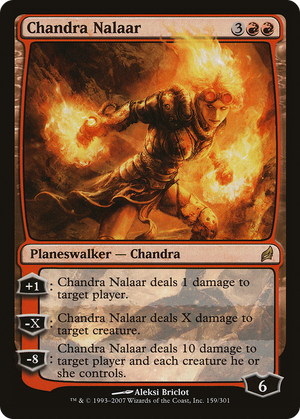
Chandra Nalaar


Part of the first wave of planeswalkers, when the card type was still being calibrated, and the design choices here read like a deliberately conservative opening bid. The plus ability pokes a player or planeswalker for a single point: a trickle, not a clock, which kept her from running away with games the way later red walkers would. The minus is the workhorse, a scalable removal valve that trades loyalty for exact damage, meaning every creature she kills walks her closer to vulnerability rather than further from it. She defends herself by spending the very resource that keeps her alive, so a board that keeps presenting threats grinds her down even as she answers it. The ultimate is the payoff the slow loyalty build promises, a board-and-face wipe that arrives only after several turns of survival, which is the genre convention this design helped establish: the ultimate as a reward for protecting the walker, not a button you reach quickly. Compared to the red planeswalkers that followed, the rate is unhurried and the floor is modest, but that restraint is the point of an early template, where Wizards had not yet learned how much loyalty a removal-walker could safely generate. She is the prototype for the burn-everything-then-burn-the-player archetype that red planeswalkers have refined ever since.